- Mount Agung, Bali's most sacred volcano, anchors the entire region. Its 1963 eruption shaped the coastline and destroyed two royal water palaces.
- Temples like Lempuyang and Besakih predate much of Bali's later Hindu architecture, some dating back to the 11th century.
- Lempuyang's famous "Gate of Heaven" photo spot now has a queue system due to crowds.
- Tenganan village preserves pre-Hindu Bali Aga customs and rare geringsing weaving.
- Virgin Beach's white sand sits just minutes from black volcanic sand near Goa Lawah.
- Tukad Cepung Waterfall is best seen between 9–11am when sunlight lights it from above.
- Dive sites like the USAT Liberty wreck and Gili Biaha suit both beginners and advanced divers.
- Distances between stops are long, so a private driver (or basing near Candidasa) beats a day trip from Nusa Dua.
Eastern Bali is a gem, with rice fields, an active volcano, and temples that predate much of the island's later Hindu architecture, all within a single stretch of Karangasem regency.
Attractions here have grown busier in recent years, but plenty of the region's backroads and coastal stretches remain quiet. Renting a scooter and following those roads for a few hours, stopping at a roadside warung for nasi campur or mie goreng along the way, remains one of the more straightforward ways to see the region beyond its headline stops.
This guide covers what's worth building into a tour, the history behind each stop, and the practical side, including how far apart everything sits, which season suits which stop, and how to plan a route that works.
Guests staying at The Seed can skip the planning altogether! Our concierge team builds a tailored itinerary around any combination of local discoveries, based on the length of the stay and the group's interests.
Eastern Bali History
Eastern Bali sits under the direct influence of Mount Agung, the island's highest peak and its most sacred mountain. The volcano has erupted many times over the centuries, most recently between 2017 and 2019, and its most violent eruption, in 1963, reshaped much of the coastline below and destroyed two of the region's royal water palaces.
The black and grey sand beaches, the terraced hillsides, and the temples that face the mountain are all direct results of that volcanic history.
The Karangasem kingdom ruled this stretch of coast into the twentieth century, and its legacy remains in two restored water palaces, a royal compound in Amlapura, and a network of irrigation channels and shrines still in daily use.
Inland, the village of Tenganan has held its own system of governance and land ownership for generations, a tradition that predates Hinduism's arrival on the island. Offshore, the coastline drops into the Coral Triangle, the richest marine biodiversity zone on the planet, and a cluster of islets reachable by boat within an hour holds some of the best diving in the region.
All of this sits within a compact stretch of coast and hill country, which is what makes eastern Bali worth touring as a region.
Best Spots To Visit in East Bali
Visit Pura Agung Lempuyang Temple (The Gate of Heaven)
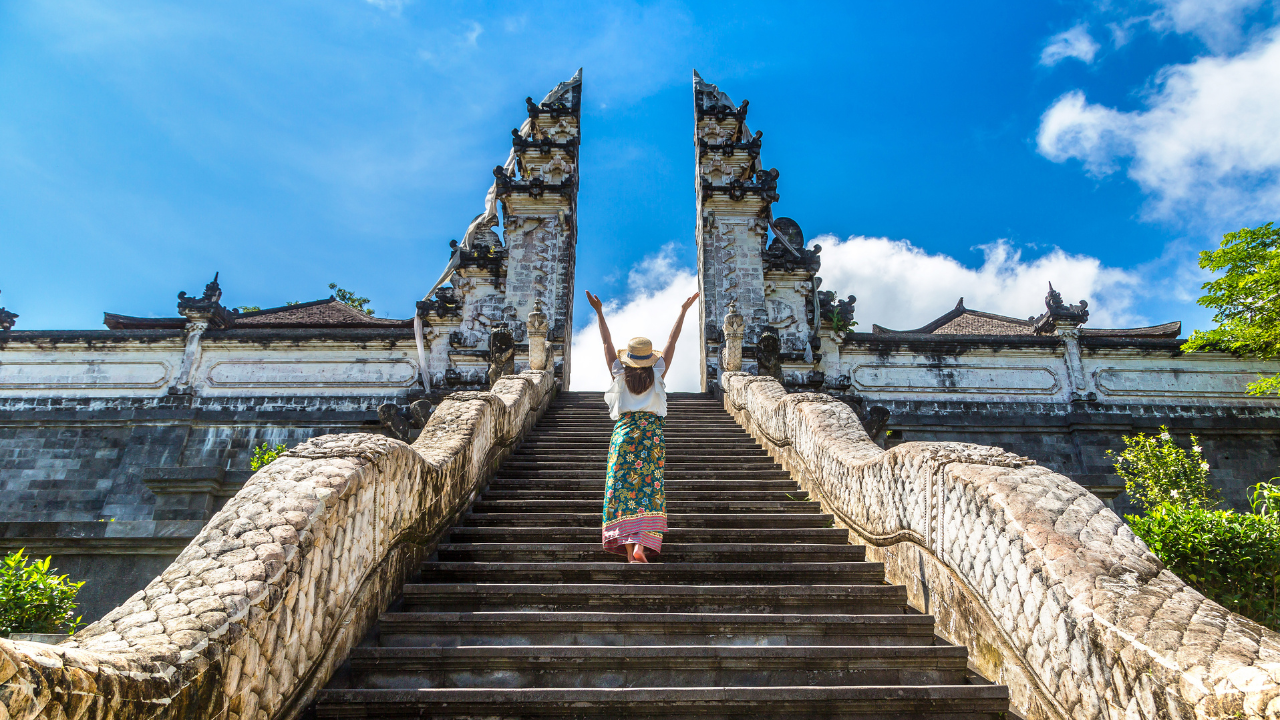
Lempuyang Temple sits high on the slopes of Mount Lempuyang, one of the oldest and most sacred sites and ancient temples on the island. Pura Lempuyang is known as the Gates of Heaven. Balinese tradition places it among the island's directional temples, positioned to hold spiritual balance from the east, and some accounts trace its origins back as far as the 11th century, predating much of Bali's later Hindu architecture. Pura Lempuyang is one of Bali's six holiest temples.
The name comes from "lempu," meaning light, and "hyang," a term for the divine, a fitting description for a temple built to catch the sunrise from Bali's eastern edge. Seven temple complexes rise up the mountain in stages, though only the first is open to general visitors; the remaining six sit higher up the slope and are reserved largely for prayer.
That first complex holds the site's defining feature of a split stone gate, or candi bentar, framing a direct line of sight to Mount Agung. On a clear morning, the volcano appears to sit squarely inside the gate, an alignment that is entirely deliberate, and one that has turned this single spot into one of the most photographed locations in Bali. The temple has drawn far larger crowds in recent years, and a queue system now manages the wait for a turn at the gate itself, which can run past an hour at busy times.
Besakih Temple, Bali's Mother Temple
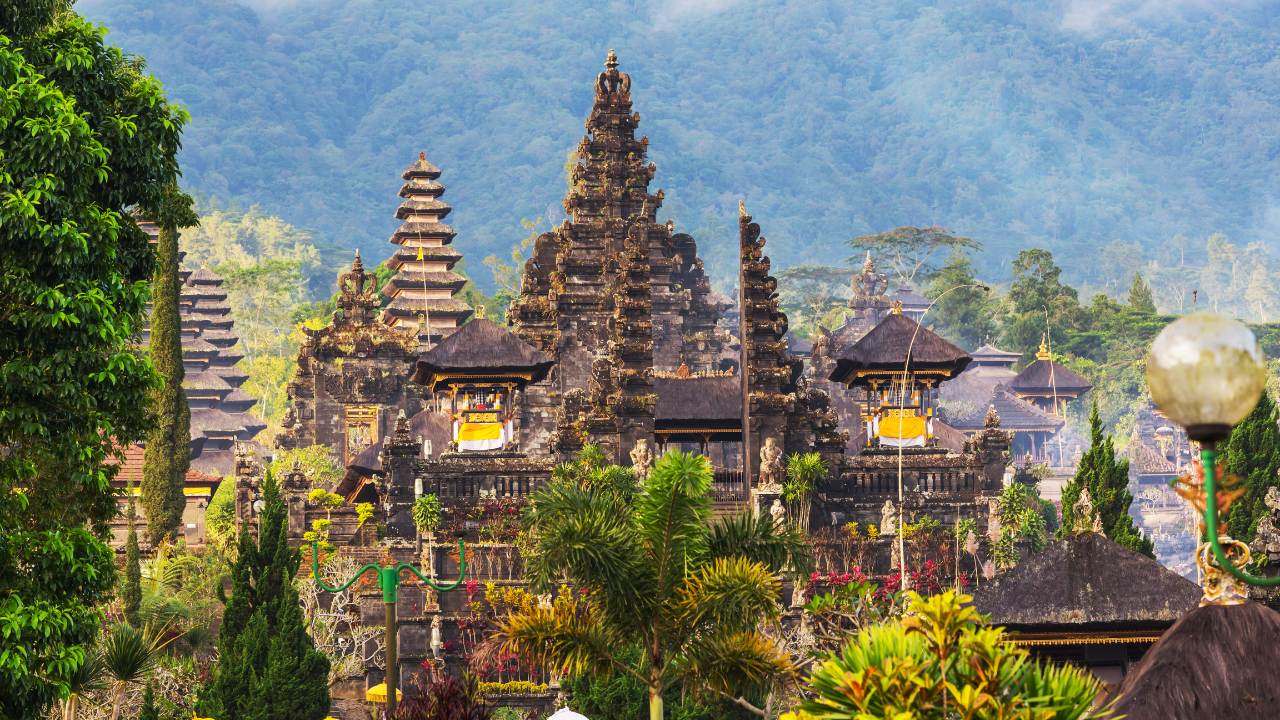
Besakih Temple sits on the southwestern slopes of Mount Agung, roughly 1,000 meters up the mountain, and holds the title of the largest and most important temple complex on the island. More than eighty individual shrines and structures spread across a series of terraced courtyards, connected by long stone staircases that climb the hillside.
At the center sits Pura Penataran Agung, the temple's main structure and its most significant shrine, dedicated to Shiva and built following the Balinese Hindu concept of Tri Hita Karana, a philosophy centered on harmony between people, nature, and the divine. Besakih's origins reach back more than a thousand years, and the complex has functioned as an active pilgrimage site for that entire span, drawing Hindu worshippers from across Indonesia for ceremonies and offerings.
The temple has survived a long run of volcanic activity on the mountain it sits on, including the catastrophic 1963 eruption that devastated much of the surrounding region while leaving Besakih itself largely intact, an event many Balinese regard as evidence of the site's spiritual standing.
Given the scale of the grounds and the near-total absence of signage, a guide adds genuine value here, helping explain which courtyards are open to visitors and which are reserved for ceremony. A sarong and sash are required throughout, and the earliest morning hours offer the clearest views back down toward the terraced hills and out toward the coast.
Goa Lawah, the Bat Cave Temple
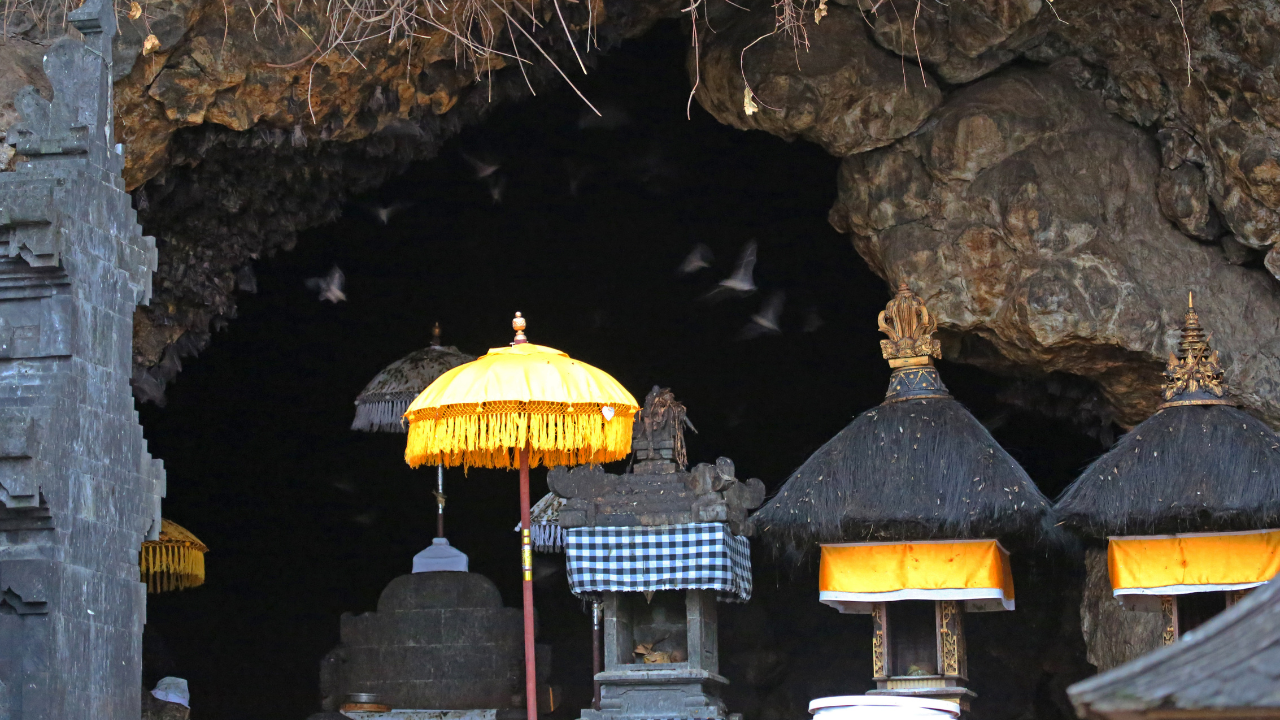
Goa Lawah sits directly on the coast road, roughly ten kilometers south of Candidasa, built around the mouth of a cave inhabited by a dense colony of fruit bats. The name translates simply to Bat Cave, and the temple ranks among Bali's directional temples, positioned along the southeast coast to hold spiritual balance from the sea. Two large banyan trees frame the main entrance, and the central courtyard holds shrines dating back to the temple's founding in the 11th century by Mpu Kuturan, one of the priests credited with laying the foundations of Hinduism on the island.
Carvings throughout the complex depict Naga Basuki, the mythical dragon believed in Balinese tradition to keep the cosmos in balance, and local legend holds that the cave itself connects underground to Besakih Temple at the foot of Mount Agung, though the passage has never been confirmed.
The temple sits beside a stretch of black sand beach, with the outline of Nusa Penida visible across the water on a clear day, and it functions as a working stopover for locals traveling the coast road, who pull in to leave offerings and pray before continuing their journey east or west. Morning visits catch the site at its quietest, ahead of both the coast road traffic and the bats' evening activity, which picks up noticeably around dusk.
Tirta Gangga and Taman Ujung Water Palace
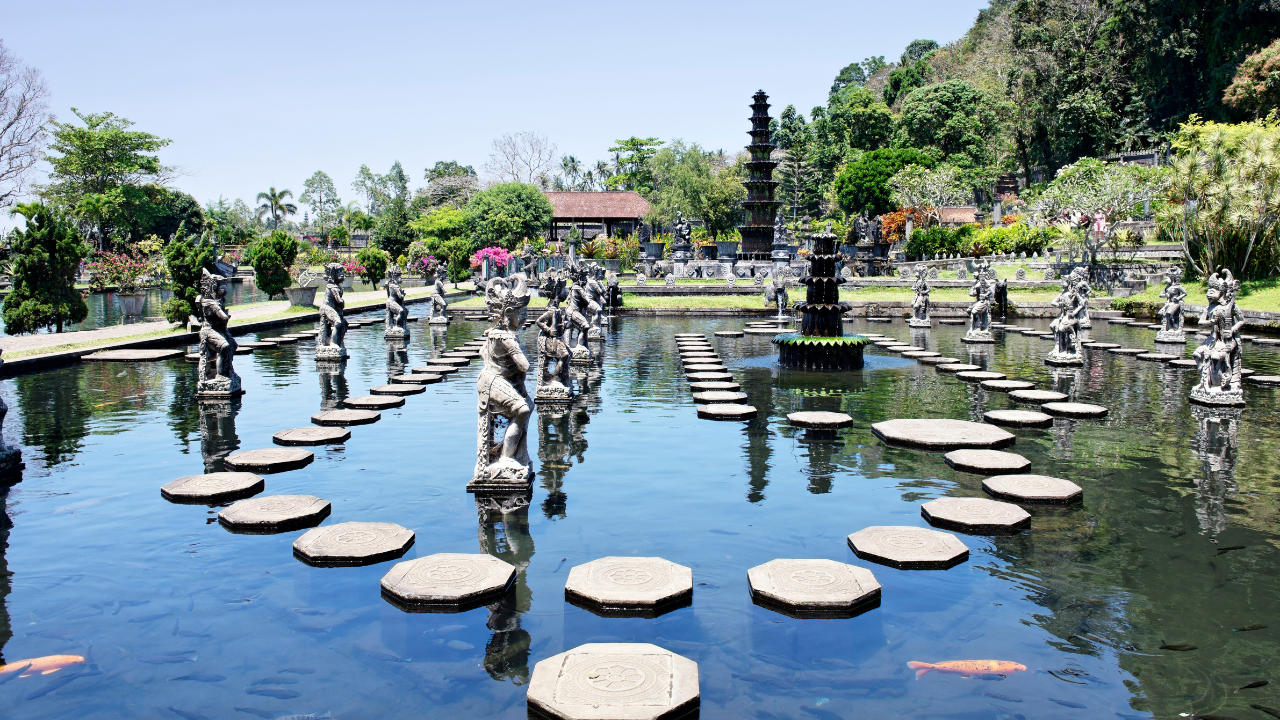
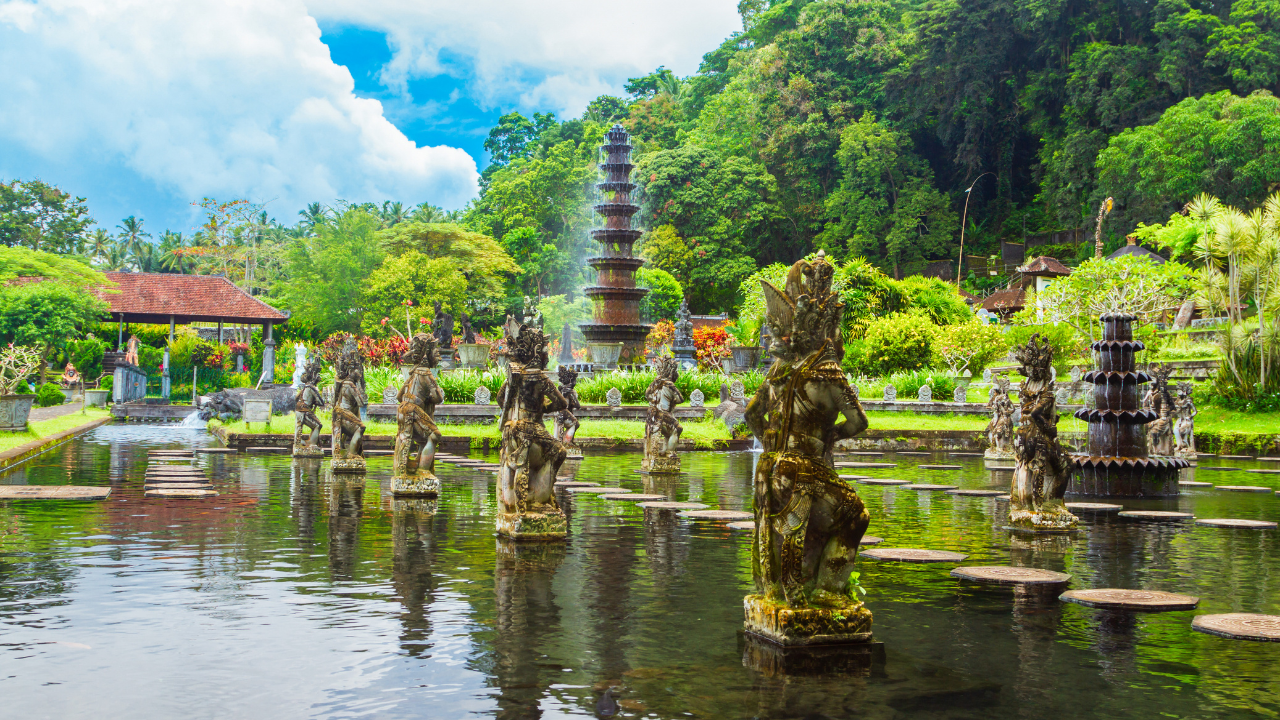
Tirta Gangga was built in 1946 by I Gusti Bagus Jelantik, the last king of Karangasem, as a recreation ground for the royal family, arranged around a series of ornamental ponds, fountains, and stone carvings fed by natural springs on higher ground to the northwest. Stepping stones cross the largest pool, letting visitors walk directly out across the water, past koi fish gliding beneath the surface and an eleven-tiered fountain at the site's center.
Mount Agung's 1963 eruption destroyed most of the original palace, and the site has since been rebuilt and restored to something close to its original layout, retaining the terraced rice fields and hillside backdrop that surrounded it from the start. A short drive south, Taman Ujung Water Palace predates Tirta Gangga by roughly three decades, completed around 1919 to 1921 under the same royal line.
Taman Ujung suffered damage from both the 1963 eruption and a 1979 earthquake, and its restoration has run at a slower pace than Tirta Gangga's, drawing fewer visitors as a result despite a similarly striking layout. Both palaces sit within the same royal legacy as the Puri Agung Karangasem palace compound in nearby Amlapura, the seat of the Karangasem kingdom itself, and together the three sites map out the built history of the last dynasty to rule this part of Bali.
Tenganan, a Bali Aga village
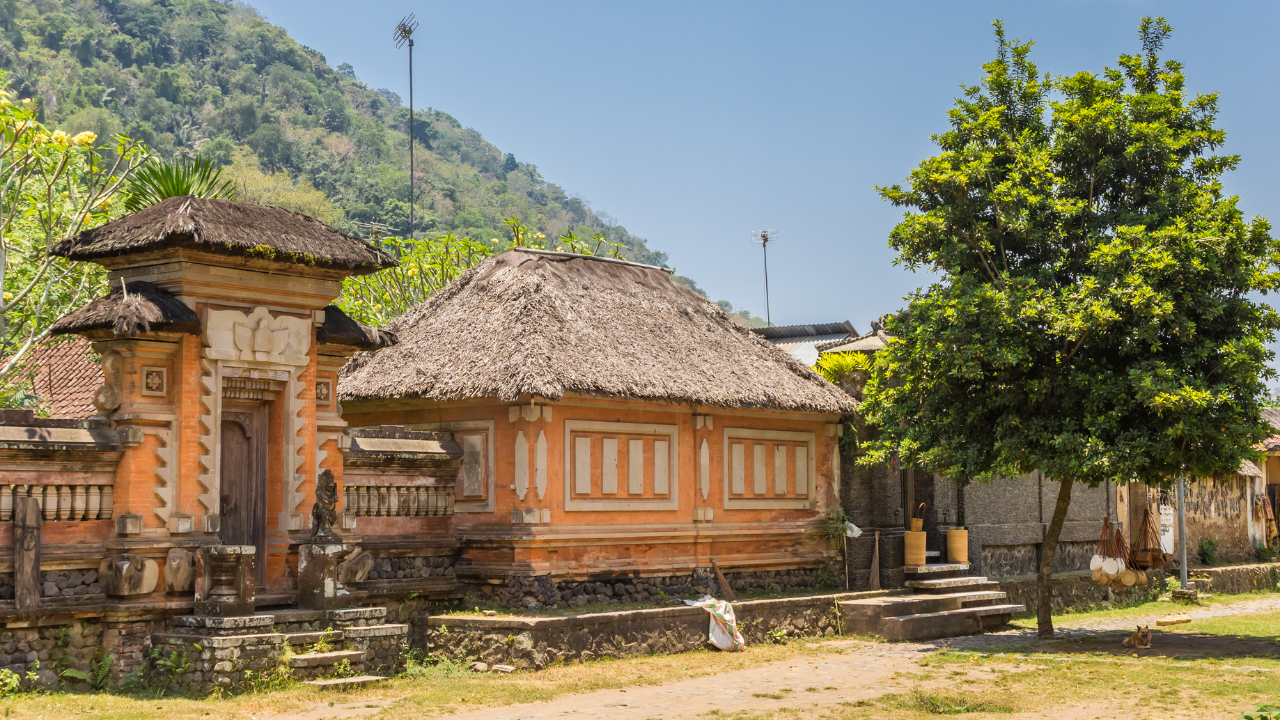
Tenganan sits within walking distance of Candidasa and is considered one of the oldest villages on the island, home to a Bali Aga community whose customs predate Bali's Hindu period and have carried through largely undisturbed since.
The village follows its own system of communal land ownership and governance, distinct from the structures found in most other Balinese villages, and its stone-paved lanes run past open-fronted homes where residents still practice traditional crafts in view of visitors. Tenganan's defining craft is geringsing, a double-ikat weaving technique that dyes both the warp and weft threads before weaving, a slow, multi-stage process found in only a handful of places in the world.
A guided walk through the village covers the weaving process directly, along with the village's layout and its approach to governance, and pairs naturally with a stop at Goa Lawah or the water palaces given its short distance from the coast.
Virgin Beach and the Black Sand Coastline
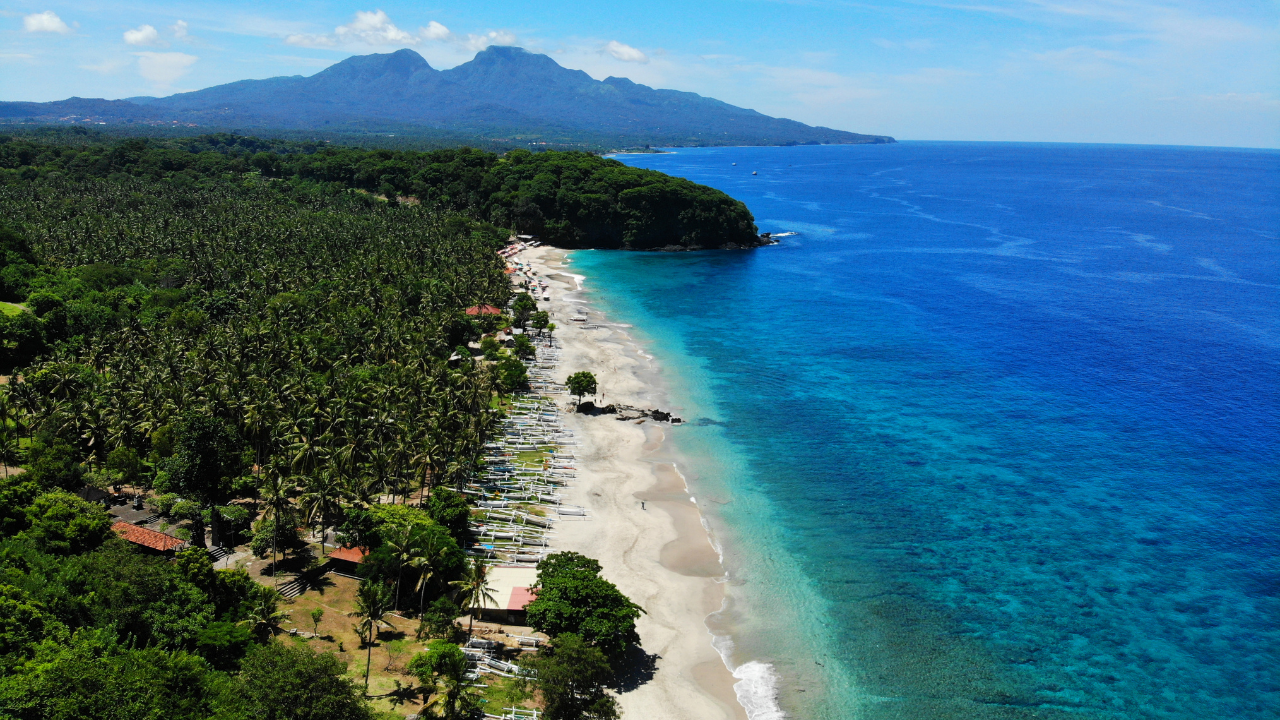
Virgin Beach, known locally as Pasir Putih, sits along an unpaved final stretch of road that has kept visitor numbers well below the busier points along East Bali's coastline. White sand and calm, swim-friendly water make the beach suited to most ages and abilities, and a line of beachside warungs along the tree line gives a shaded place to eat and rest between swims, a good spot for lunch on a longer day of touring.
Further along the coast, past Goa Lawah and toward Candidasa, the sand shifts to the black and grey volcanic material that defines much of East Bali's shoreline, a direct result of Mount Agung's eruption history. That contrast, white sand at Virgin Beach against the black sand stretches nearby, gives this coastline a visibly different character within a short drive. Virgin Beach works as a standalone beach day or as the final stop on a longer circuit taking in the water palaces on the drive there or back, the same combination arranged through The Seed's own Virgin Beach day trip.
Tukad Cepung Waterfall
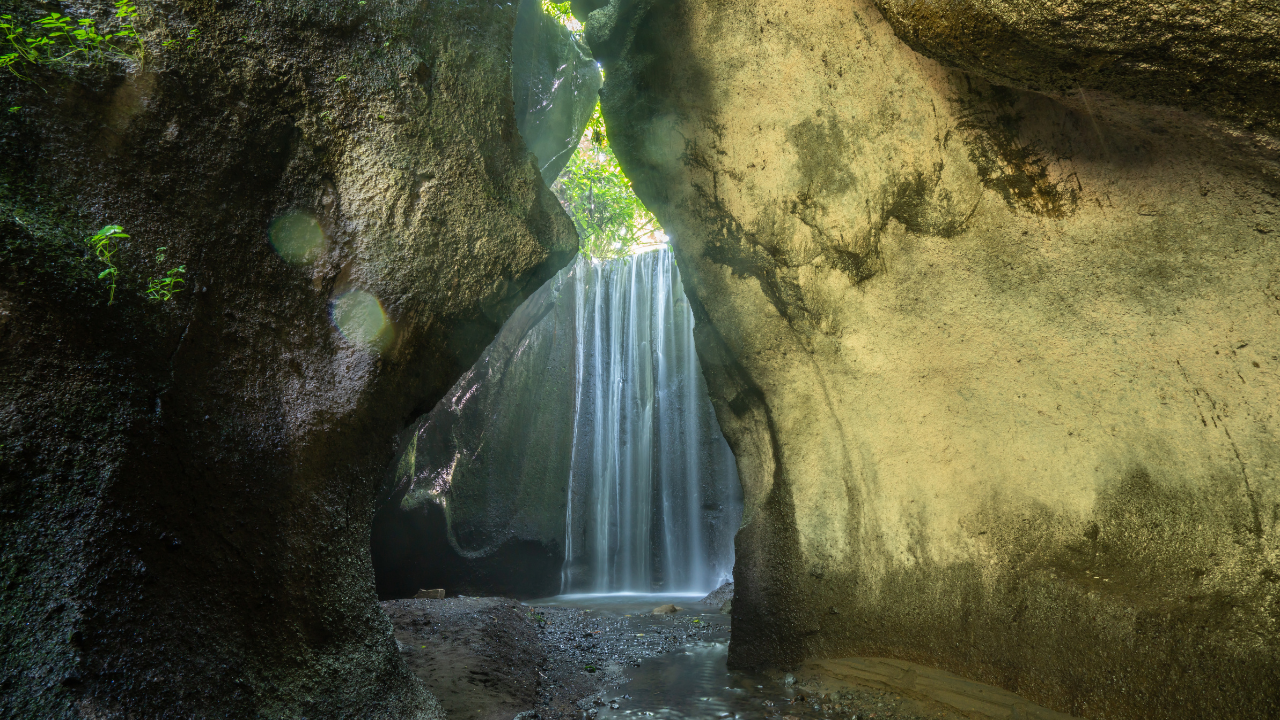
Tukad Cepung sits in a narrow canyon near Tembuku, on the edge of Bangli regency, and stands apart from most waterfalls in Bali in how its water reaches the ground. Rather than feeding into an open river, the water drops through a circular gap in the rock high above a hidden gorge, falling into a shallow pool inside what functions as a natural amphitheater of stone.
Between roughly nine and eleven in the morning, direct sunlight breaks through that opening and lights the falling water from above, an effect that depends entirely on the sun's position and is at its strongest on clear days. Reaching the falls means a walk down a series of stone steps followed by a wade through a shallow stream between the canyon walls, a short trek rather than a demanding one, and the payoff is a waterfall lit from directly overhead rather than from the side, a setup found in very few other places on the island.
Tukad Cepung sits further inland than most stops on a typical East Bali circuit, so it fits best into a day built around Mount Batur or the drive back down through the hill country rather than the coastal temple rout
Mount Agung and Mount Batur
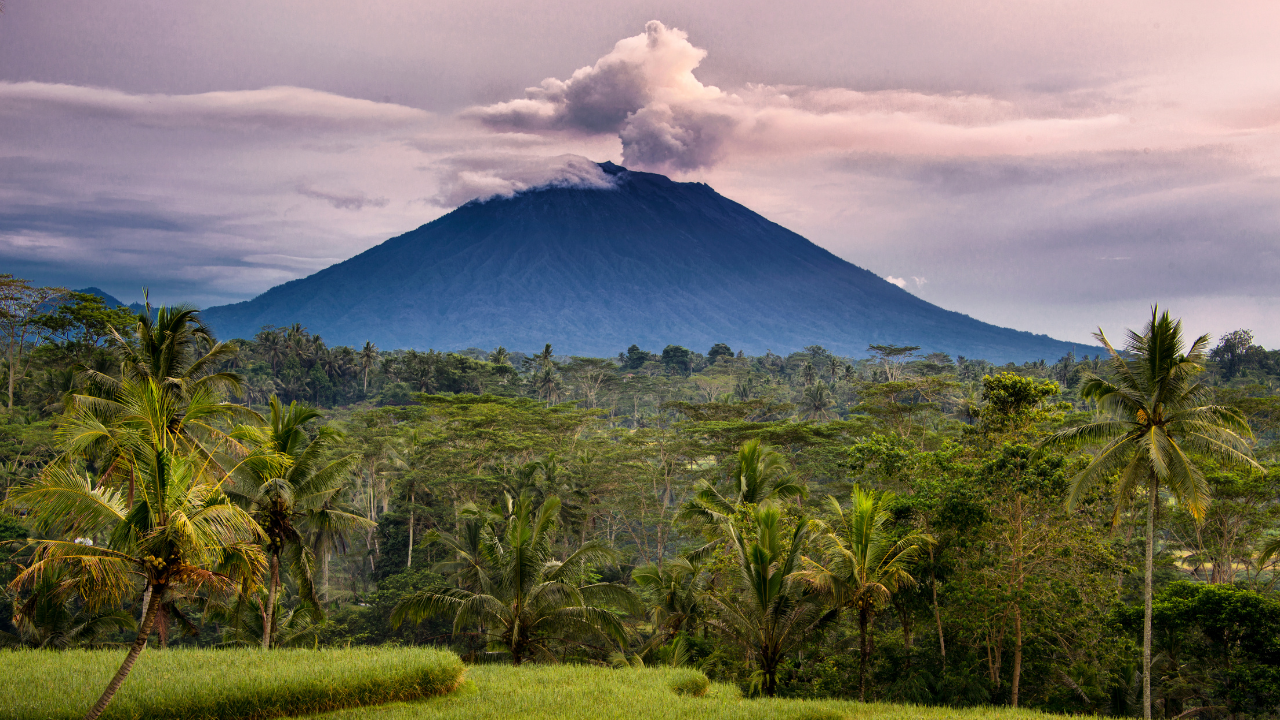
Mount Agung is Bali's highest point and its most sacred mountain, an active volcano whose last major eruption, in 1963, reshaped much of Karangasem's coastline and destroyed both of the region's royal water palaces. More recent activity between 2017 and 2019 closed the mountain to climbers for extended periods, and access depends on current conditions and permits at the time of a visit. Mount Agung's summit is visible from Lempuyang, Besakih, and much of the eastern coastline, and it functions as a visual anchor for nearly every temple and water palace on an east Bali tour.
Mount Batur, further inland toward Kintamani, sits lower and sees far more regular foot traffic, with a guided sunrise trek that starts around four in the morning and reaches the crater rim as the sun comes up over the surrounding caldera lake. A jeep tour across Mount Batur's black lava fields offers a lower-effort alternative, covering the same volcanic terrain from a vehicle with stops at viewpoints along the way, suited to visitors who want to see the mountain's terrain up close without the early start or the physical demands of the trek.
Dive Sites in East Bali
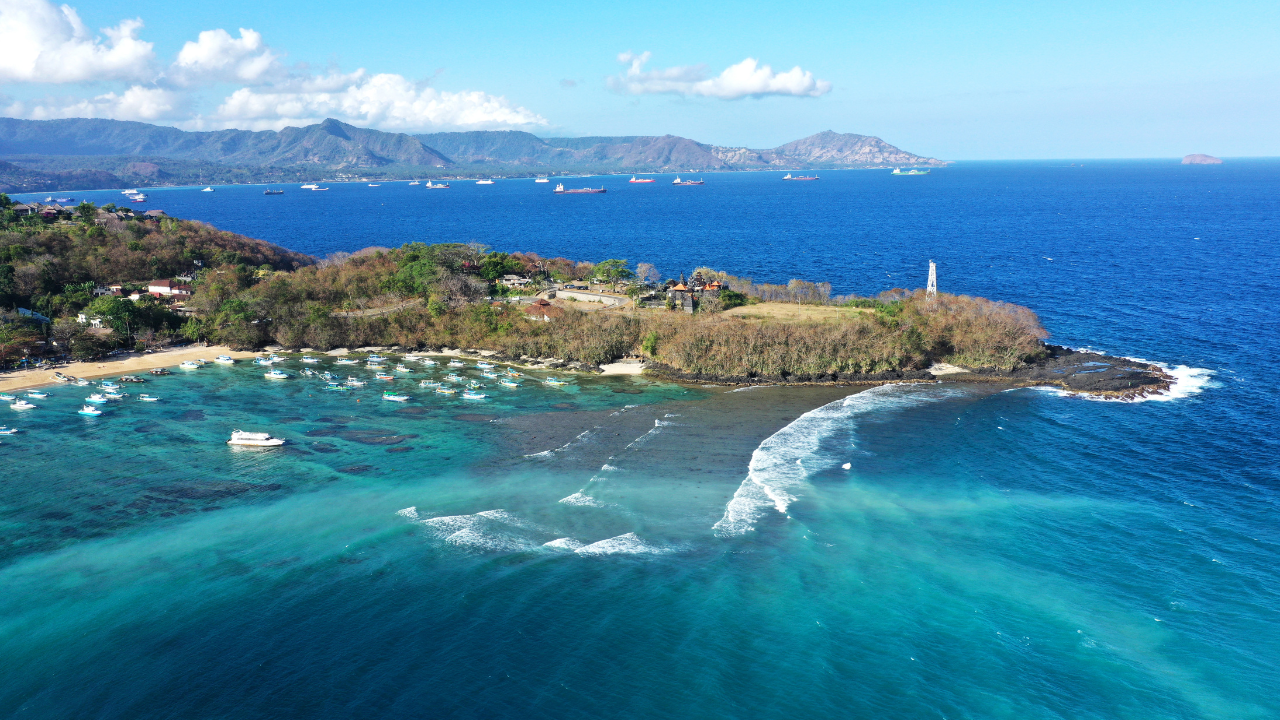
Gili Tepekong
Gili Tepekong's east wall runs from around 14 to 40 meters, cut through by a canyon lined with basalt boulders and soft coral, and its signature feature, the Blue Hole, threads through the rock at around 18 to 21 meters before opening onto a sheer wall. The site sits exposed to currents sweeping through the Lombok Strait, which has earned it a reputation as one of Bali's more demanding dives. Divers sometimes call it "the toilet" for its swirling downdrafts, and a trustworthy guide who can read the surface conditions is essential here. In exchange for that respect, Tepekong offers some of the most dramatic underwater scenery in the area, along with reliable sightings of whitetip reef sharks resting in the canyon.
Gili Mimpang
Gili Mimpang offers a mix of sandy bottom, sloping reef, and drop-off, with visibility regularly reaching 25 to 30 meters. Also known locally as Batu Tiga ("three rocks"), it sits around ten minutes by boat from Padang Bai and typically ranges from about 16 to 30 meters deep, with rocky terrain that draws confident, experienced divers.
Gili Biaha
Gili Biaha centers on a shark cave where white tip reef sharks rest by day. The cave sits at around 12 to 20 meters on the island's eastern side, and beyond it the reef drops to 40 meters or more, with strong currents drawing schooling trevally and barracuda. The surrounding reef also supports a dense cover of hard and soft coral, gorgonian fans, and sponges, home to moray eels, lobsters, octopus, and the occasional bamboo shark tucked into the shallower crevices.
Divers regularly encounter eagle rays, barracuda, and Napoleon wrasse, and during the dry season months of July through October, the oceanic sunfish, or mola mola, draws to cleaning stations on the reef.
Blue Lagoon
Just around the point, Blue Lagoon offers a calmer, shallower alternative, with a sandy-bottomed bay opening onto coral reef around 15 to 16 meters, well suited to a first open water dive or a relaxed snorkel from the beach. Also known as Baong Penyu, or "turtle's neck," it's just a short jukung boat ride from Padang Bai's harbor, with a gently sloping sandy bottom on one side and a wall on the north side dropping to around 30 meters and covered in feather stars. It's a favorite for macro photography too, as divers regularly spot seahorses, nudibranchs, ribbon eels, and stonefish tucked into the sand.
Amed
Further north, roughly 45 minutes to an hour from Candidasa, Amed adds a different kind of diving. The Japanese Wreck, a WWII-era patrol boat resting in shallow water and swallowed by soft coral, sits close enough to shore for a confident snorkeler to explore directly, and Jemeluk Bay's calm, current-free slope suits both first dives and night diving. The wreck itself lies at a shallow 2 to 12 meters, with the surrounding slope continuing down to a coral plateau around 35 meters for those who want to go deeper, and its hull now supports gorgonian fans, sponges, and a busy population of lionfish, moray eels, and glassfish. Jemeluk Bay, meanwhile, is known as one of Bali's best spots for macro photography, with sightings of ghost pipefish, mimic octopus, and pygmy seahorses among the reef life.
Tulamben
Tulamben sits a short drive beyond Amed and holds the region's best-known dive site: the USAT Liberty shipwreck. The USAT Liberty, a 120-meter US Army cargo ship torpedoed by a Japanese submarine in January 1942 and beached on Tulamben's shore for salvage, sat there for two decades until Mount Agung's 1963 eruption pushed it back into the water. The USAT Liberty shipwreck lies 50 meters offshore in Tulamben today, resting on its side across a depth range of about 5 to 30 meters, with coral grown across the hull supporting giant garden eels, sweetlips, humphead parrotfish, reef sharks, and the occasional turtle.
A shore entry gets divers to the wreck in under a minute, and the shallowest sections stay reachable by snorkelers at low tide. Originally built in 1918, the ship spent both World Wars in service before its final journey from Australia to the Philippines was cut short off Lombok. Today it's considered one of the most accessible wreck dives anywhere in the world, drawing both first-time wreck divers and underwater photographers, with night dives here especially prized for the nocturnal life that emerges around the hull.
Find more dive sites on our Diving & Snorkelling page.
Common questions
What does an east Bali tour typically include?
An east Bali tour typically links temples aligned to Mount Agung, one or both of the region's royal water palaces, a stop at Virgin Beach or another stretch of coastline, and time in the water around Padang Bai. Most itineraries in Karangasem regency combine two to four of these stops into a single day, with a fuller circuit spread across two or three days.
Do you need a private tour to see East Bali properly?
A private tour, arranged with a private car and driver, is the standard way to link more than one or two stops in a single day, given how far apart the temples, palaces, and beaches sit across Karangasem regency. A private tour also allows the itinerary to adjust around temple ceremonies, weather, and the group's own pace.
How far is East Bali from Nusa Dua?
Nusa Dua sits roughly two to three hours from the temples and water palaces covered on a typical east Bali tour, making a same-day round trip from that side of the island a long one. Basing a stay closer to Candidasa, on Bali's east coast, cuts that drive time significantly for anyone touring the region over more than a single day.
Stays
Enjoy family holidays, reunions, and quiet time together.
Learn more →
Retreats
Lead a life-changing retreat.
Learn more →