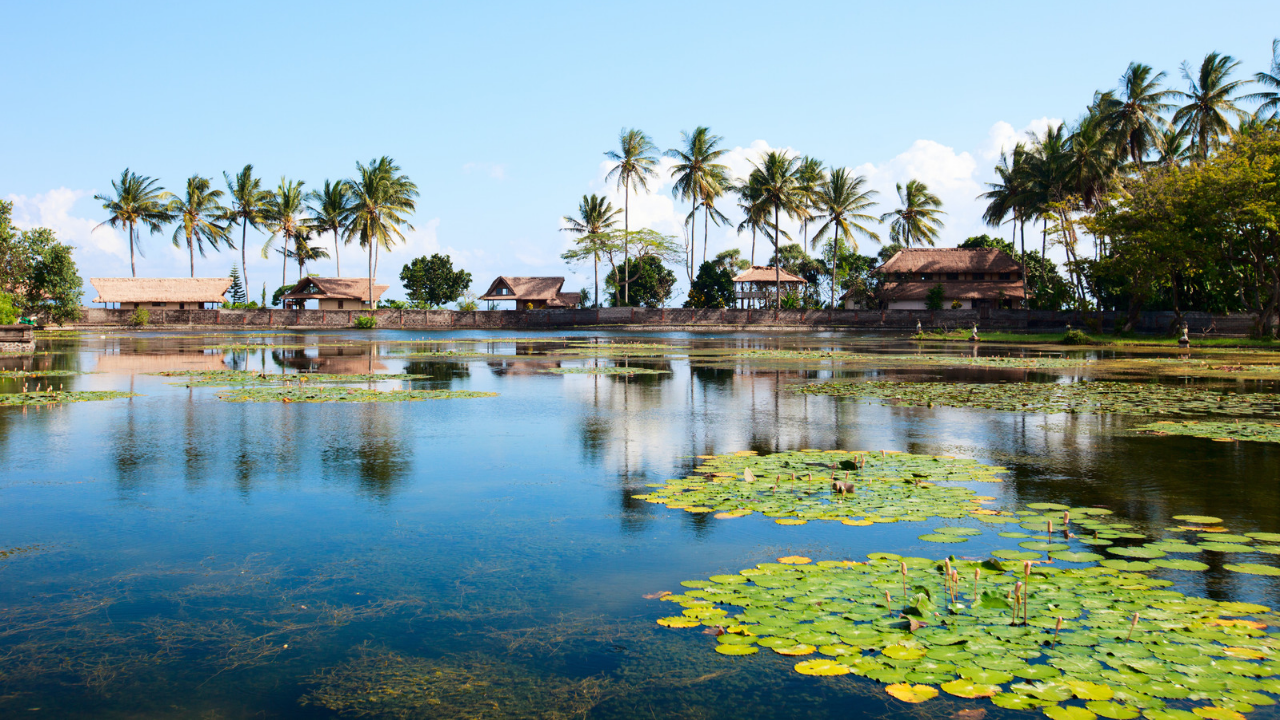
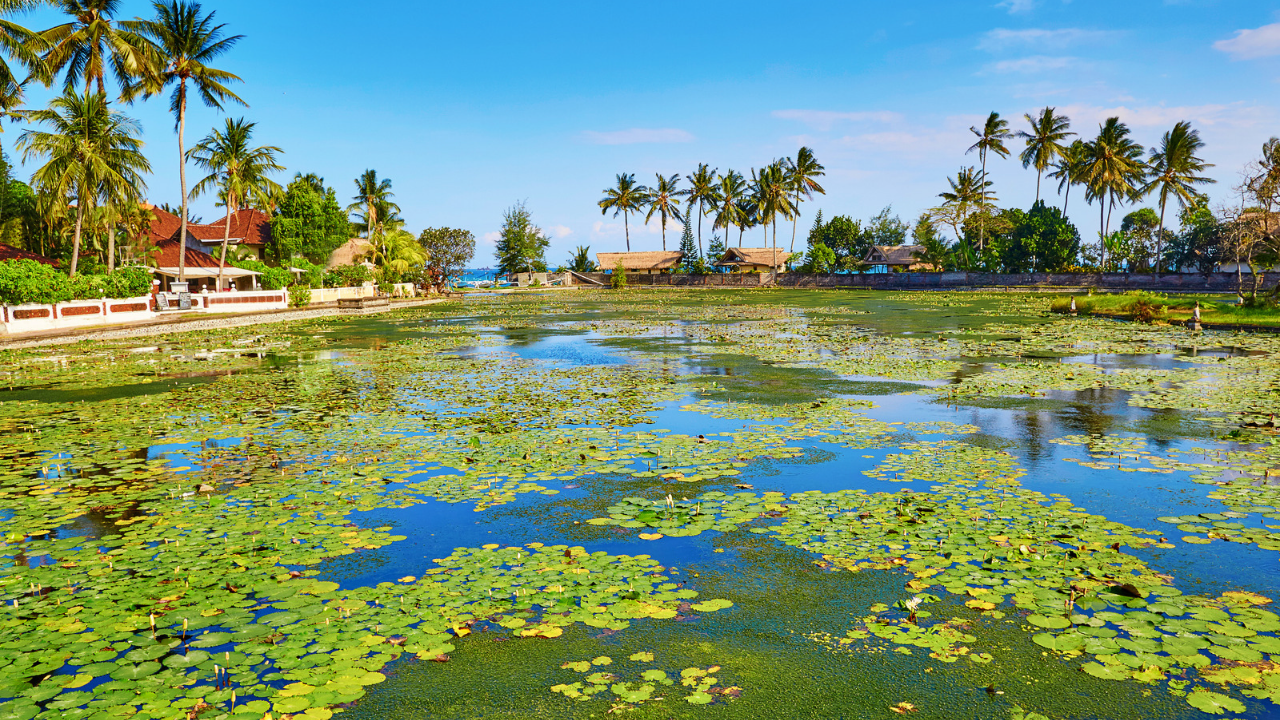
- Lotus Lagoon is a freshwater lagoon of about 1,000 square metres in central Candidasa.
- The lagoon sits on the main road, between the town and the sea.
- Pink, purple and white lotus flowers cover the water alongside water lilies.
- A small garden island with stone statues sits at the centre of the lagoon.
- Frangipani trees and tropical palms line the lagoon’s edges.
- The lagoon is home to fish, frogs, dragonflies, birds and lizards.
- The flowers bloom from around 6 to 10 am and close by midday.
- The lagoon is free to visit and open 24 hours a day.
Lotus Lagoon Candidasa is a freshwater lagoon in the middle of Candidasa, a seaside town on the east coast of Bali. Covered in pink lotus flowers and water lilies, the lagoon lies between the main road and the sea, with a temple rising up the hillside directly across the road. This beautiful lotus lagoon is the landmark most visitors to the town photograph first, and it has been at the centre of local life for as long as the town has existed.
This guide covers how the lagoon formed, its place in Balinese culture, the creatures that live in and around it, a set of lesser-known facts, and how to plan a visit.
The Lagoon, the Temple and the Town of Ten Children
The cultural relevance of the lagoon begins across the road at Pura Candidasa, a twin temple built into the hillside. One shrine honours Shiva. The other honours Hariti, a fertility goddess whose roots trace back to the Buddhist traditions that once spread across Java and Bali. In Bali she is also known as Men Brayut, the mother of many children.
Local legend tells of a goddess who longed for children. Her prayers were answered, and she gave birth to ten children from her first pregnancy. A statue of Hariti surrounded by small figures stands in the temple, and the most widely accepted origin of the town's name traces to cili dasa, meaning "ten children." A second reading interprets the name as candi dasa, meaning "ten temples." Both point back to the temple above the lagoon.
Balinese couples still travel to Pura Candidasa to pray for children, and drivers passing through often stop at the roadside shrine to place offerings and ask for a safe journey. The temple's anniversary ceremony, known as piodalan, follows the 210-day Pawukon calendar and falls on Anggara Kasih, a sacred Tuesday in the cycle. Visitors who happen to arrive during the ceremony see families in ceremonial dress carry towering offerings along the edge of the lagoon and up the temple steps, while the whole site fills with gamelan, incense and colour.
The temple's lower shrine sits close to the water, so the lagoon and the temple read as a single sacred site from the road. A long flight of stone steps climbs to the upper complex, and from the top, visitors look down over the lagoon, the rooftops of the town and the bay. On clear days, the view reaches the offshore islets.
The Lotus in Balinese Culture
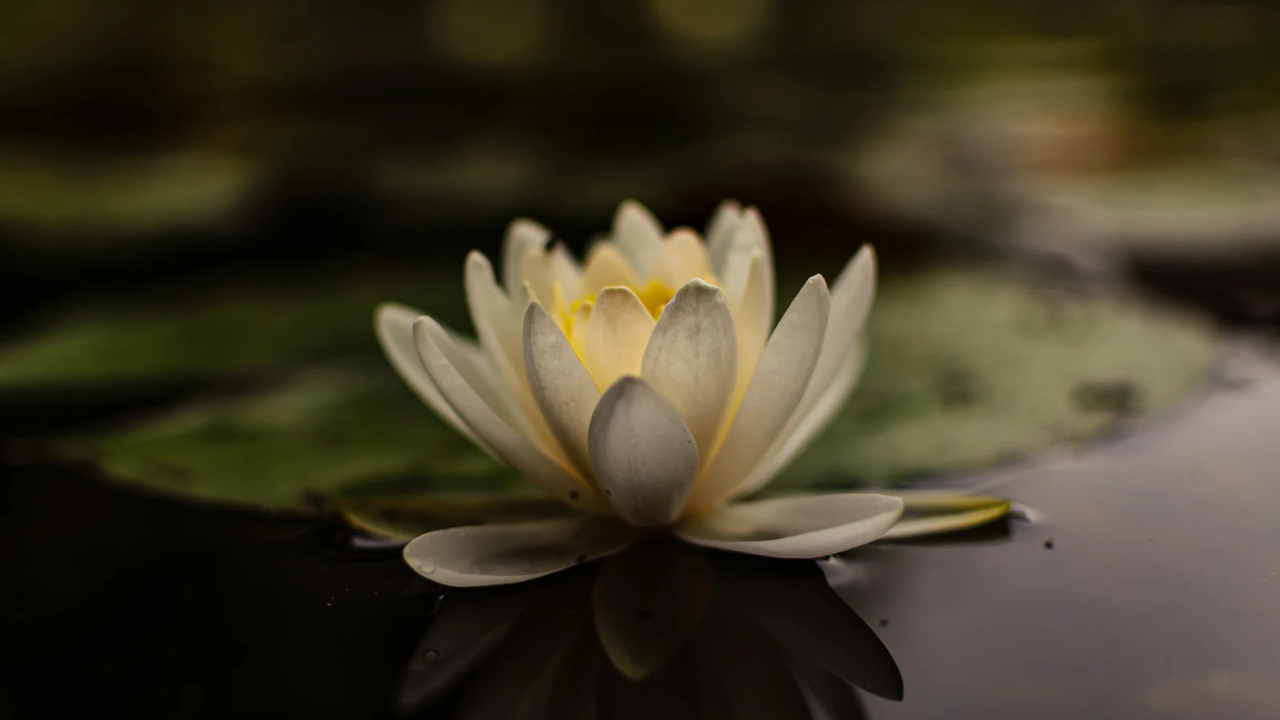
The lotus holds a central place in Balinese culture and in Hindu thought more broadly. The flower rises from mud to bloom clean above the water, which makes it a symbol of purity, spiritual growth and divine order.
In Bali, that symbolism appears in the architecture of almost every temple. The padmasana, or lotus throne, is a tall stone shrine crowned with an empty seat, dedicated to Sang Hyang Widhi Wasa, the supreme god of Balinese Hinduism. The word comes from padma, meaning lotus, and asana, meaning seat. The shrine stands in the most sacred position in a temple compound and is often the focus of prayer.
The lotus also shapes the Balinese map of the universe. In the Dewata Nawa Sanga, nine guardian deities preside over the eight compass directions and the centre. The arrangement is commonly drawn as an eight-petalled lotus, with one deity on each petal and Shiva at the centre. A lotus-filled lagoon beside a temple dedicated to Shiva and Hariti carries that meaning in living form, right in the middle of town.
Creatures That Live In and Around the Lagoon
The lagoon supports a small freshwater ecosystem in the centre of a busy coastal town, and the best time to watch it is early in the morning.
Fish
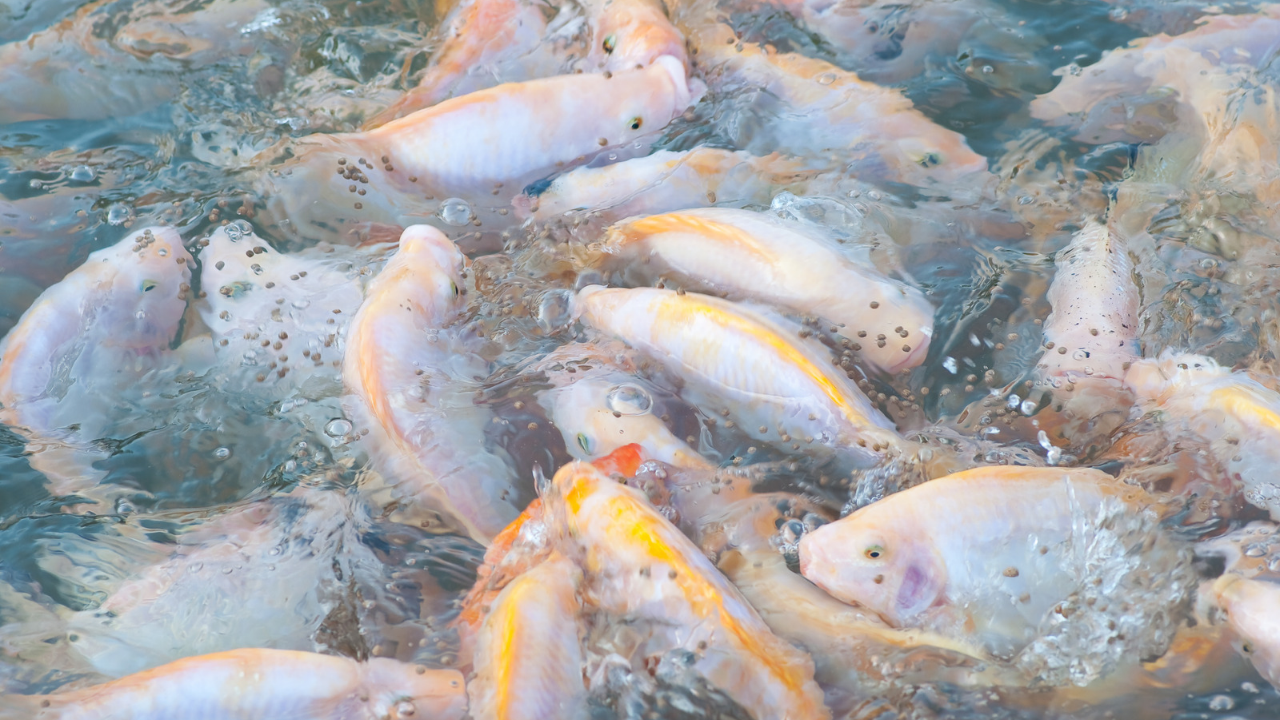
- Nile tilapia (Oreochromis niloticus): Nile tilapia are the most common fish in Bali’s lowland ponds. They move through the shallows between the lily stems, and kids enjoy spotting them from the path. Local residents sometimes fish for them with simple lines.
- Striped snakehead (Channa striata): Known locally as ikan gabus, the striped snakehead is a long, dark predator that hunts along the muddy bottom. It breathes air at the surface, which lets it thrive in warm, shallow water.
- Guppy (Poecilia reticulata): Shoals of guppies gather near the edges. The males carry bright flecks of orange and blue, and the fish feed on mosquito larvae close to the surface.
Frogs and Toads
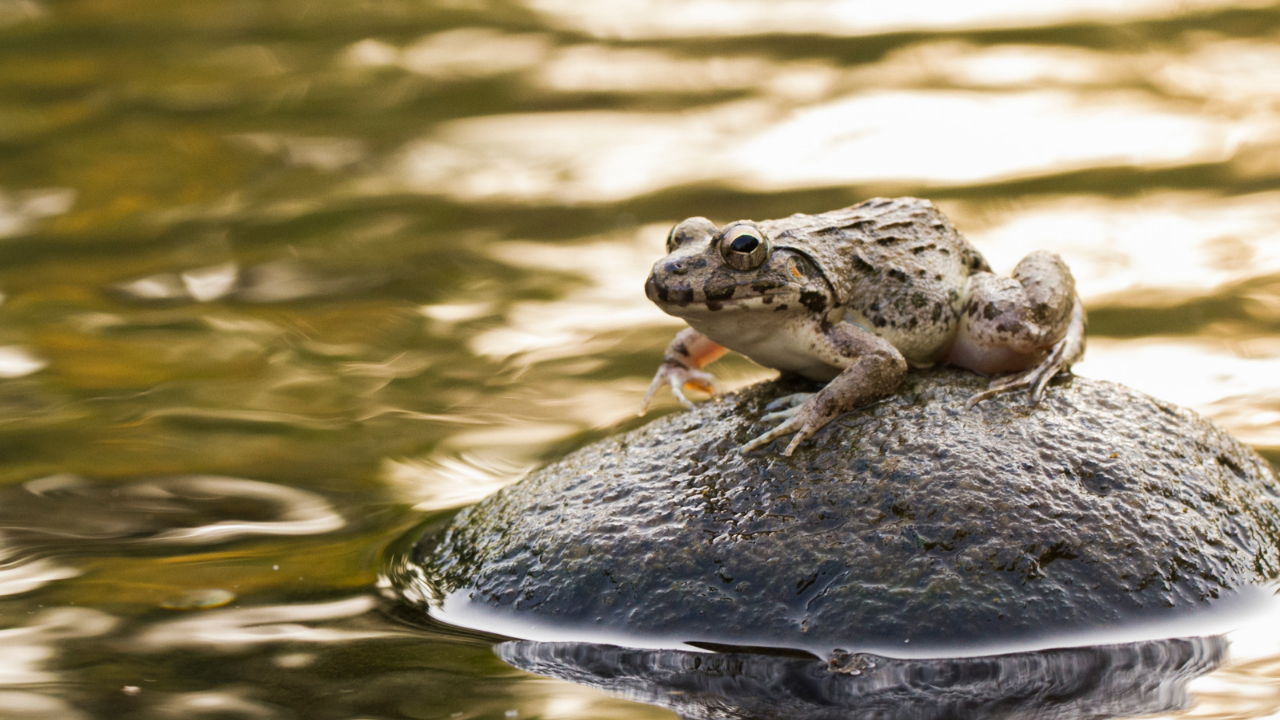
- Crab-eating frog (Fejervarya cancrivora): The crab-eating frog is one of the few frogs able to live in slightly salty water, which suits a lagoon this close to the sea. It rests along the muddy margins and calls loudly after rain.
- Four-lined tree frog (Polypedates leucomystax): This pale brown frog has four faint stripes down its back and climbs the stems and plants around the water. It lays its eggs in foam nests attached to leaves above the surface.
- Asian common toad (Duttaphrynus melanostictus): The Asian common toad feeds along the path at dusk, picking off insects drawn to the lights of the main road. Its trilling call carries across the water in the evening.
Dragonflies and Damselflies
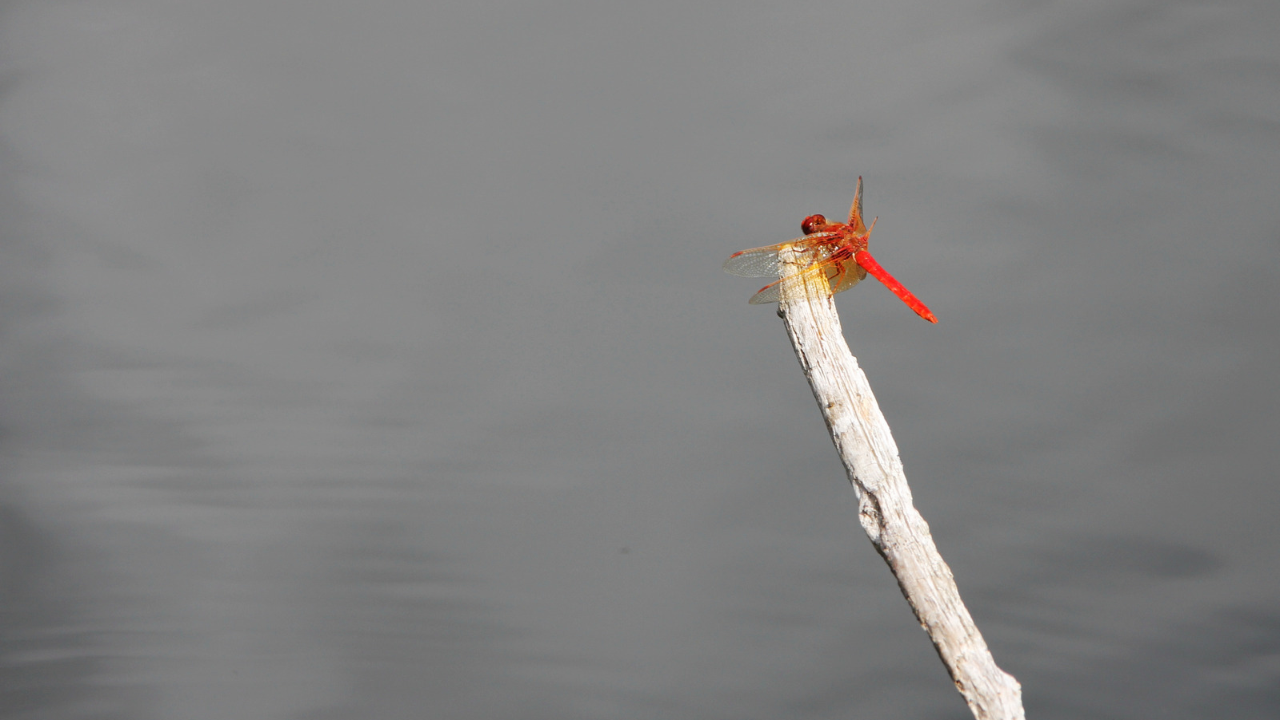
- Crimson marsh glider (Trithemis aurora): This is the easiest dragonfly to spot at the lagoon. The males are bright magenta and perch on lily stems between short hunting flights.
- Wandering glider (Pantala flavescens): The golden-orange wandering glider patrols higher over the water in loose groups. It is one of the longest-distance insect migrants in the world, crossing oceans on seasonal winds.
- Pseudagrion damselflies: Slender, bright blue damselflies rest along the margins with their wings folded over their backs and hunt small insects just above the surface.
Dragonfly and damselfly larvae live underwater and feed on mosquito larvae, which helps keep the lagoon in balance.
Birds
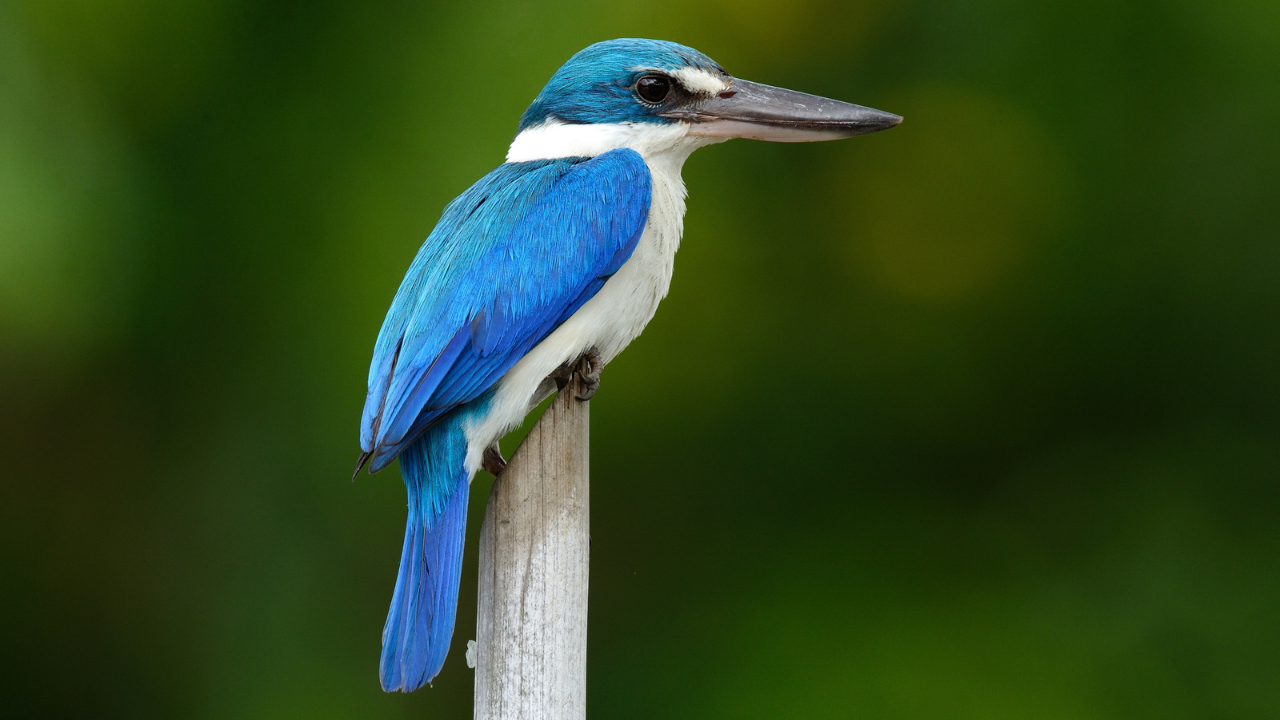
- Collared kingfisher (Todiramphus chloris): Turquoise above and white below, the collared kingfisher is common along Bali’s coast. It perches above the water before diving for small fish.
- Javan kingfisher (Halcyon cyanoventris): Found only on Java and Bali, the Javan kingfisher has a deep blue body, a brown head and a bright red bill. It visits wetlands and paddies across the island’s lowlands.
- Javan pond heron (Ardeola speciosa): This small heron stands still in the shallows, waiting to strike at fish and frogs. Its plumage looks dull brown at rest and flashes white in flight.
- Little egret (Egretta garzetta): The little egret is a slim white wading bird with black legs and yellow feet. It walks slowly through the shallows and stirs up prey with its feet.
- Pacific swallow (Hirundo tahitica): The Pacific swallow skims the surface for insects in the late afternoon. Migrating barn swallows join it between September and April.
Lizards
- Common house gecko (Hemidactylus frenatus): This gecko lives in the walls, shrines and lamp posts around the lagoon and gathers near lights after dark to catch moths.
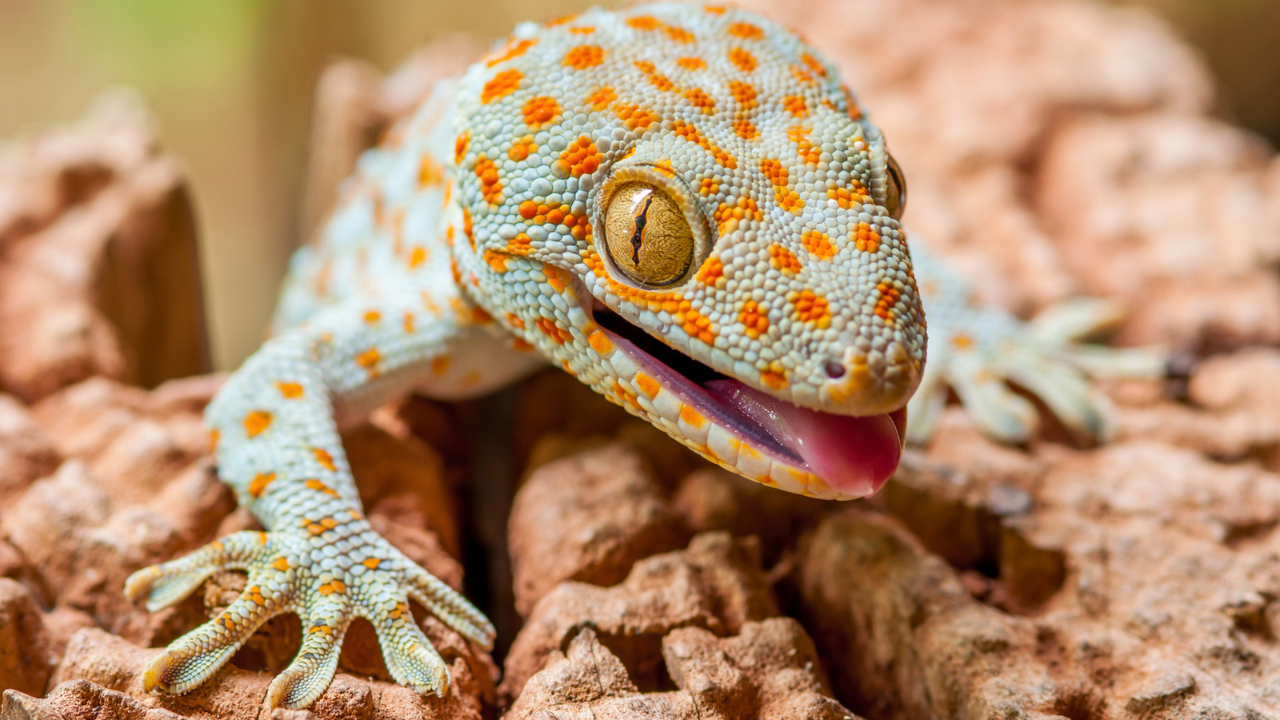
- Tokay gecko (Gekko gecko): The tokay is large and blue-grey with orange spots. Its loud two-note call, “to-kay,” is a familiar evening sound across Bali.
- Common sun skink (Eutropis multifasciata): This glossy bronze skink basks on warm stones along the path and darts into cover when approached.
- Asian water monitor (Varanus salvator): The largest lizard in the region and a strong swimmer, the water monitor is found in wetlands across lowland Bali. It feeds on fish, frogs and eggs.
Interesting Facts About the Lotus Lagoon
A Lotus or a Water Lily?
The lagoon is famous for its lotus flowers, and the surface also holds a large number of water lilies. The two plants are easy to tell apart. True lotus leaves are round and rise above the water on stems, while water lily leaves float flat on the surface and have a single notch cut into them. Looking for both is a good way to spend a few minutes at the water's edge.
Leaves That Stay Dry
Lotus leaves are covered in microscopic wax structures that repel water. Raindrops bead up into small spheres and roll off, carrying dust and dirt with them. Scientists call this the "lotus effect," and it has inspired self-cleaning paints, glass coatings and fabrics.
A Flower That Keeps Itself Warm
The sacred lotus can regulate the temperature of its own flower, holding it at around 30 to 35°C even when the surrounding air is cooler. The warmth helps release scent and gives visiting insects a comfortable place to rest, which supports pollination.
Seeds That Last for Centuries
Lotus seeds have some of the longest lifespans in the plant world. A seed recovered from a dry lakebed in China, dated at around 1,300 years old, was successfully germinated by researchers.
A Small Garden Island at the Centre
In the middle of the lagoon sits a small garden island planted with greenery and set with stone statues. The island gives the pond its focal point and appears in most photos taken from the road.
About 1,000 Square Metres of Water
The lagoon covers roughly 1,000 square metres, stretching from the roadside back toward the sand. Its size makes it easy to walk around in a few minutes.
Visiting the Lotus Lagoon: A Short Travel Guide
- The best time to visit is early morning, between sunrise and mid-morning. The flowers are open, the water is calm, the main road is quiet and the light is soft for photos, with the beauty of the lagoon at its peak. Candidasa faces east, so the morning sun rises over the bay behind the lagoon. In the late afternoon, warm light falls across the green hills behind the temple, which makes a lovely second window for photos.
- Lotus Lagoon is a public site with free entry, open at all hours. A simple path runs along part of the edge, with trees providing shade in places. Most visitors spend 15 to 30 minutes walking, sitting, relaxing and taking photos, and a combined visit to the lagoon and the temple takes about an hour. Crowds stay small throughout the day, which keeps a sense of tranquility even beside the main road. The lagoon works much like one of the small public parks found in Balinese towns.
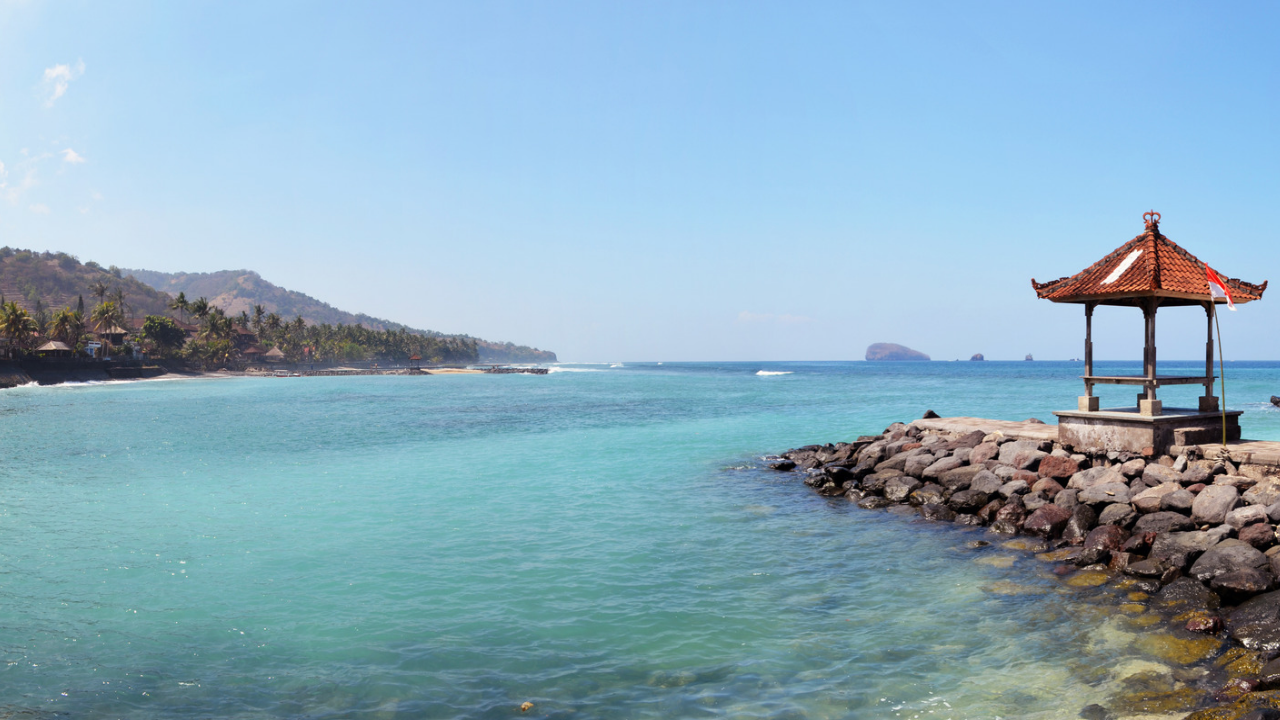
- Head down the path to the small beach on the seaward side, where traditional jukung fishing boats rest on the sand. The breakwaters keep the water calm here, and at low tide the sand widens along the shore.
- The lagoon suits families well. Kids enjoy watching the fish and frogs, and the walk is short and flat. Some sections along the water have open edges, so keep a close eye on young children.
- Some online reviews and comments mention garbage at the water's edge. Take any rubbish with you and use the bins along the main road.
- Warungs and restaurants line Jalan Raya Candidasa within a short walk of the lagoon, many serving fresh seafood from the morning catch. Ikan bakar, whole fish grilled over coconut husk, is the standard order.
Lotus Lagoon Candidasa FAQ
Where is the Candidasa Lotus Lagoon?
The Candidasa Lotus Lagoon sits in the heart of Candidasa town, on Jalan Raya Candidasa, the main road along Bali’s east coast. The lagoon fills the space between the road and the sea, directly across from the stairway to Pura Candidasa, so it is hard to miss when driving through town.
How big is Lotus Lagoon?
Lotus Lagoon spans roughly 1,000 square metres, about the area of four tennis courts. The water stretches from the roadside back toward the beach, and a walk around the lagoon takes a few minutes.
What colour are the lotus flowers at Lotus Lagoon?
The lotus flowers at Lotus Lagoon bloom in pink, purple and white, alongside the floating pads of water lilies. Frangipani trees and tropical palms line the edges of the lagoon and frame the water in photos.
What is the best time to visit Lotus Lagoon?
The best time to visit Lotus Lagoon is early morning, between 6:30 and 7 am. The lotus flowers open from around 6 am and stay in full bloom until about 10 am, then begin to close after 11 am or by midday. An early visit also means calm water, cooler air and a quiet main road.
Is there an entrance fee for Lotus Lagoon?
Lotus Lagoon is free to visit and open 24 hours a day, seven days a week. It is a public site beside the main road, with roadside parking nearby.
Can you swim at Lotus Lagoon?
Lotus Lagoon is a place for walking, sitting and taking photos, and swimmers head to the small beach on its seaward side. The breakwaters along the Candidasa shore hold calm water in a string of sandy coves, which suits a short swim after a walk around the lagoon. Guests at The Seed can also return to the estate’s ocean-front pool.
What temple is near Candidasa Lotus Lagoon?
Pura Candidasa, a temple dating to around the 12th century, stands directly across the road from the Candidasa Lotus Lagoon. It honours Shiva and Hariti, the goddess of fertility, and its stone stairway climbs the hillside to a view over the lagoon, the town and the bay.
How far is Lotus Lagoon from Virgin Beach?
Virgin Beach is about 15 minutes by car from Lotus Lagoon, which makes the two easy to combine in one trip. Known locally as Pantai Pasir Putih, Virgin Beach has white sand, crystal clear water and warungs serving fresh seafood under the palms.
What village can I visit near Candidasa Lotus Lagoon?
Tenganan, a walled Bali Aga village, is a 10-minute drive from the Candidasa Lotus Lagoon. The Bali Aga are among the island’s original inhabitants, and Tenganan is known for geringsing, a double-ikat cloth woven by families in open-fronted homes along the village lanes.
Tell us what you have in mind and we will come back with what the estate can hold.

Plan your vacation
Family holidays, reunions, and quiet time together, by the sea in Candidasa.
Learn more →
Host your retreat
A venue for facilitators, with a full hospitality team behind every session.
Learn more →