- Pura Lempuyang is a complex of seven temples on Mount Lempuyang in the Karangasem Regency of East Bali.
- Pura Lempuyang Luhur, the summit temple, is one of the Sad Kahyangan Jagad, the six holiest places in Bali.
- The temple honours Iswara, the Balinese Hindu deity who guards the east and is associated with the colour white.
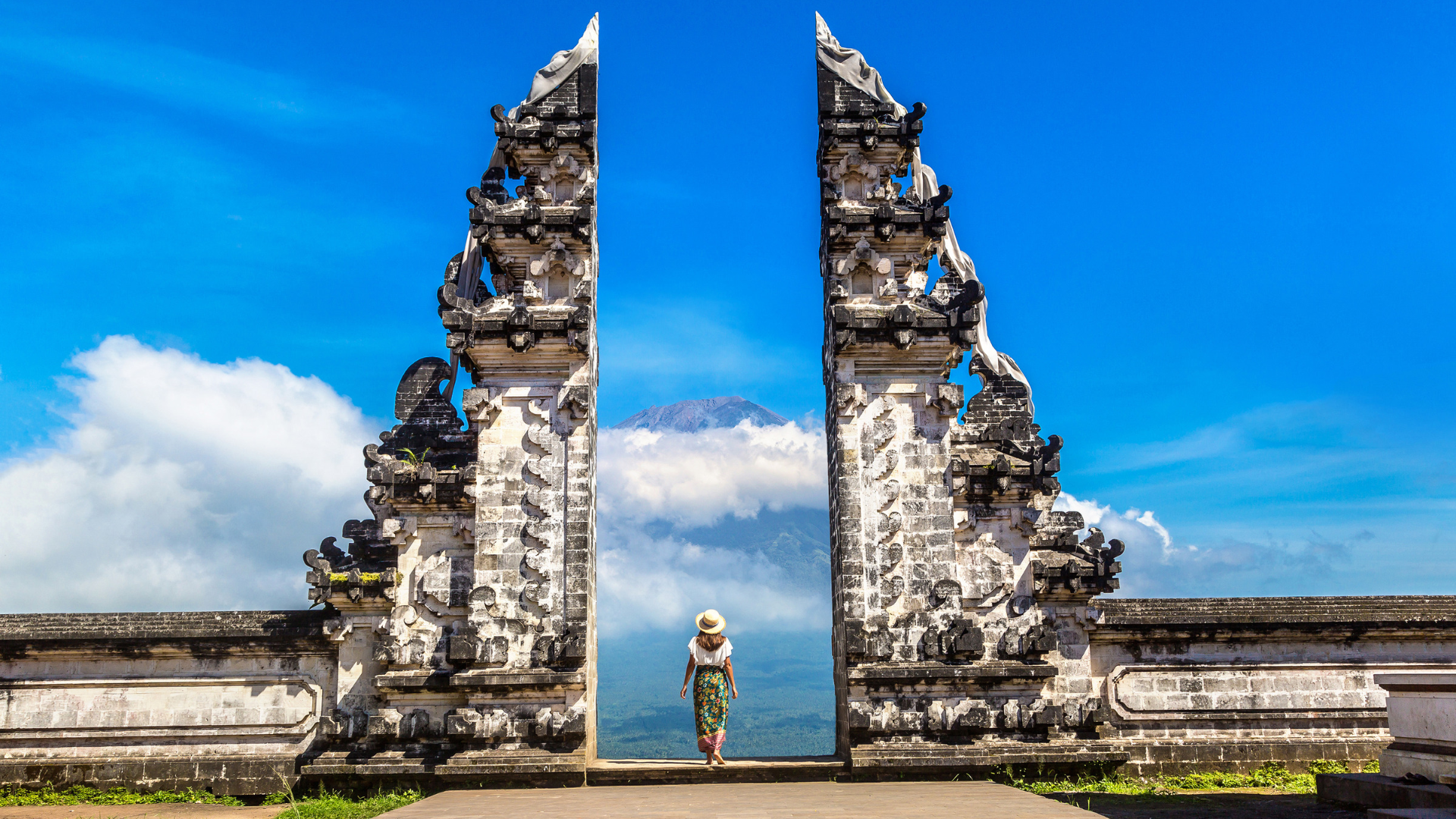
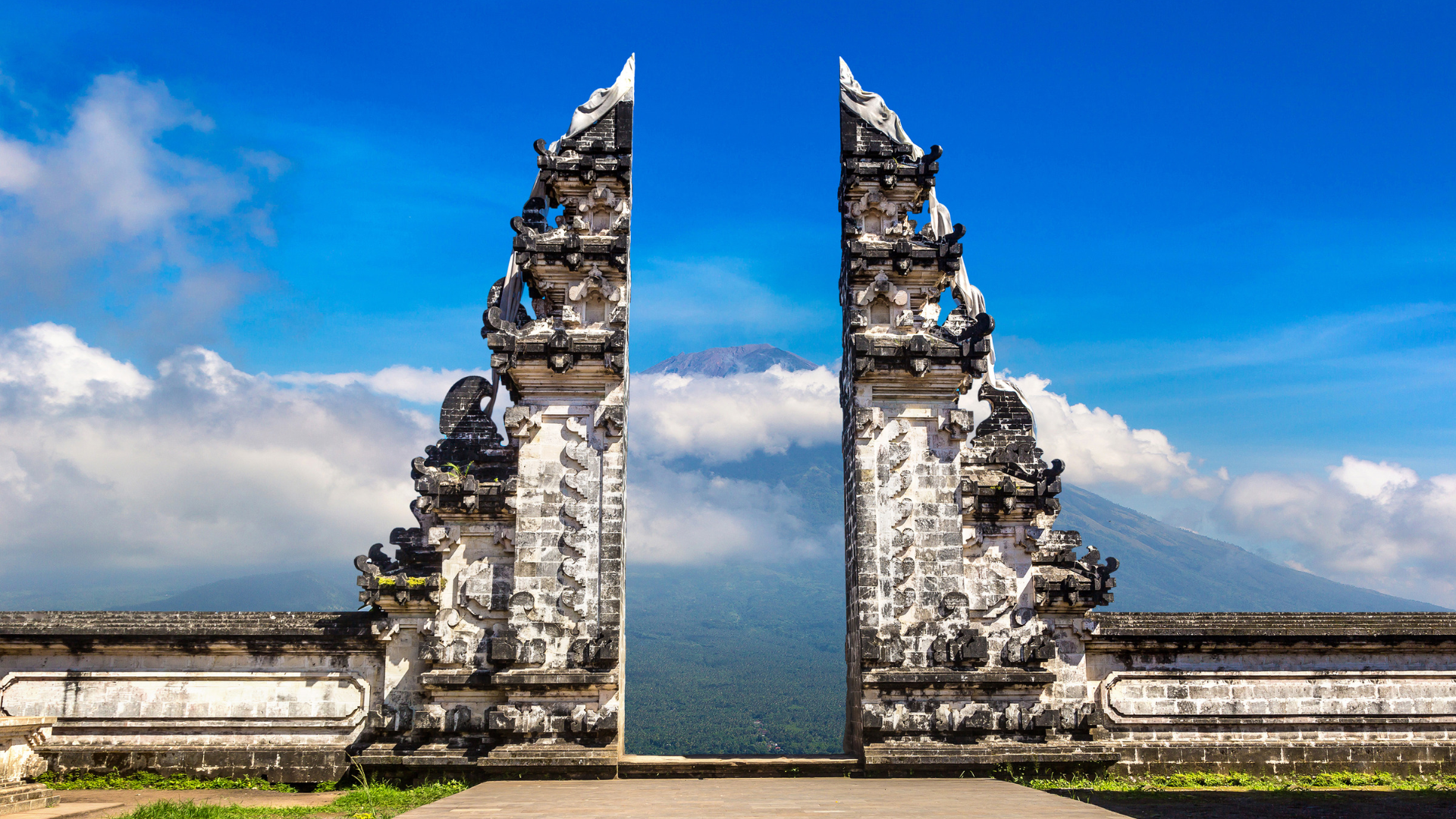
- The Gate of Heaven sits at Pura Penataran Agung Lempuyang, the first and lowest temple in the complex.
- The reflection in the famous gate photos comes from a small mirror held beneath the camera lens.
- Reaching the summit temple involves roughly 1,700 steps and several hours of climbing.
Lempuyang Temple Bali is a sacred Balinese Hindu temple complex on the slopes of Mount Lempuyang in East Bali, made up of seven temples that climb from the lower forest to the summit. Known locally as Pura Lempuyang, it ranks among the oldest temples on the island and holds a place among the Sad Kahyangan Jagad, the six holiest places of worship in Bali. To most of the world, it is the Gate of Heaven, and consists of a tall white split gate that frames Mount Agung across the valley. To the Balinese, it is the guardian of the east and the first point on the island to receive the light of the rising sun.
What Is Lempuyang Temple?
The name "Lempuyang Temple" covers an entire sacred mountain. Pura Lempuyang refers to a group of seven temples linked by a single stone path that rises from the lower slopes of Mount Lempuyang to its peak. Each temple is a stage in a spiritual journey, and pilgrims traditionally pray at each one in turn as they climb.
The main temple, in a religious sense, is Pura Lempuyang Luhur at the top of the mountain. "Luhur" translates as "high" or "noble", and this summit sanctuary is the focus of worship for the whole complex. The temple most visitors know, however, is Pura Penataran Agung Lempuyang, the lowest of the seven, where the white gates and the dragon staircases stand. When people speak of the Gate of Heaven, this is the temple they mean.
Where Is Lempuyang Temple Located?
Lempuyang Temple is located in the Abang District of the Karangasem Regency, the easternmost regency of Bali. The temple's official address sits within Tribuana village, and the neighbouring Tista village is commonly referenced as a gateway to the mountain. The regency capital, Amlapura, lies a short drive to the southwest.
Pura Penataran Agung Lempuyang stands at roughly 600 metres above sea level, on the southwest face of the mountain. Pura Lempuyang Luhur sits close to the summit, with published elevations ranging from about 1,060 to 1,175 metres above sea level. From the lower temple, the view runs west across the valley to Mount Agung, the highest volcano in Bali and the island's most sacred peak. On clear mornings, the volcano fills the space between the two halves of the split gate.
The History and Origins of Pura Lempuyang
The establishment of places of worship around Mount Lempuyang is believed to predate most Hindu temples in Bali, which is why the complex is counted among the oldest temples on the island. Two historical inscriptions, the Epigraph Sading C and the Epigraph Dewa Purana Bangsul, record its spiritual history.
According to the Epigraph Sading C, King Jayasakti received instructions from his father to travel to Bali and build a temple on Mount Lempuyang. The purpose was to protect the island and to draw settlers to the eastern region. Balinese tradition also links the temple's development to Mpu Kuturan, the eleventh-century priest credited with organising much of Bali's temple system and its religious teachings.
The Epigraph Dewa Purana Bangsul tells a mythological version. In it, the god Pasupati (a manifestation of Shiva) sends his children to Bali to stabilise and protect the island. Hyang Putra Jaya settles on Mount Agung, where Besakih Temple now stands. Dewi Danu settles at Lake Batur. Hyang Gni Jaya settles on Mount Lempuyang, and the summit temple became his seat. The three mountain sanctuaries remain spiritually linked today, and pilgrims often visit Lempuyang and Besakih Temple as part of the same circuit.
The name itself carries several interpretations. One reading splits it into "lampu" (light) and "hyang" (god), giving "the light of God", a fitting meaning for a temple facing the sunrise. Another connects "lempuyang" to a medicinal plant of the ginger family. "Lempuyang" is a Javanese name; the older Balinese name for the mountain is Gamongan.
Pura Penataran Agung Lempuyang was restored in 2001, and the white-washed gates and staircases visible today date from that restoration.
Spiritual Significance: The Guardian of the East
Lempuyang belongs to two groups of sacred temples, and each group plays a different role in protecting Bali.
The first group is the Sad Kahyangan Jagad, the six holiest temples on the island. The Balinese see these six temples as spiritual pillars that keep Bali in balance. Pura Lempuyang Luhur is one of them, along with Besakih Temple, which is also in the Karangasem Regency.
The second group is the Kahyangan Padma Bhuwana, nine temples placed around Bali to guard the island from every direction. Each temple protects one point of the compass, and one sits at the centre. Lempuyang guards the east.
The east belongs to Iswara, the Balinese Hindu god who protects that direction. His colour is white, and he carries a bajra, the ritual bell Balinese priests use in ceremonies.
The east also carries a deeper meaning. The sun rises there, so the Balinese link it with light, renewal and new life. People come to Lempuyang to pray for spiritual clarity, and many climb to the summit temple to collect holy water, called tirtha pingit, which they carry home for ceremonies across Bali.
Inside Pura Penataran Agung Lempuyang
Pura Penataran Agung Lempuyang follows the classic tri mandala layout of a Balinese Hindu temple, with three courtyards that rise in sacredness as a person moves toward the mountain.
Jaba Pisan: Nistaning Mandala
The outer courtyard, the jaba pisan, corresponds to the nistaning mandala, the zone closest to the everyday world. Visitors enter through a white candi bentar, the split gate that has become the iconic photo spot. Inside stand several Balinese pavilions, or bale. The rectangular bale gong houses the gamelan instruments played during religious ceremonies, and the bale kulkul holds the wooden slit drum struck to call the community to prayer.
Jaba Tengah: Madya Mandala
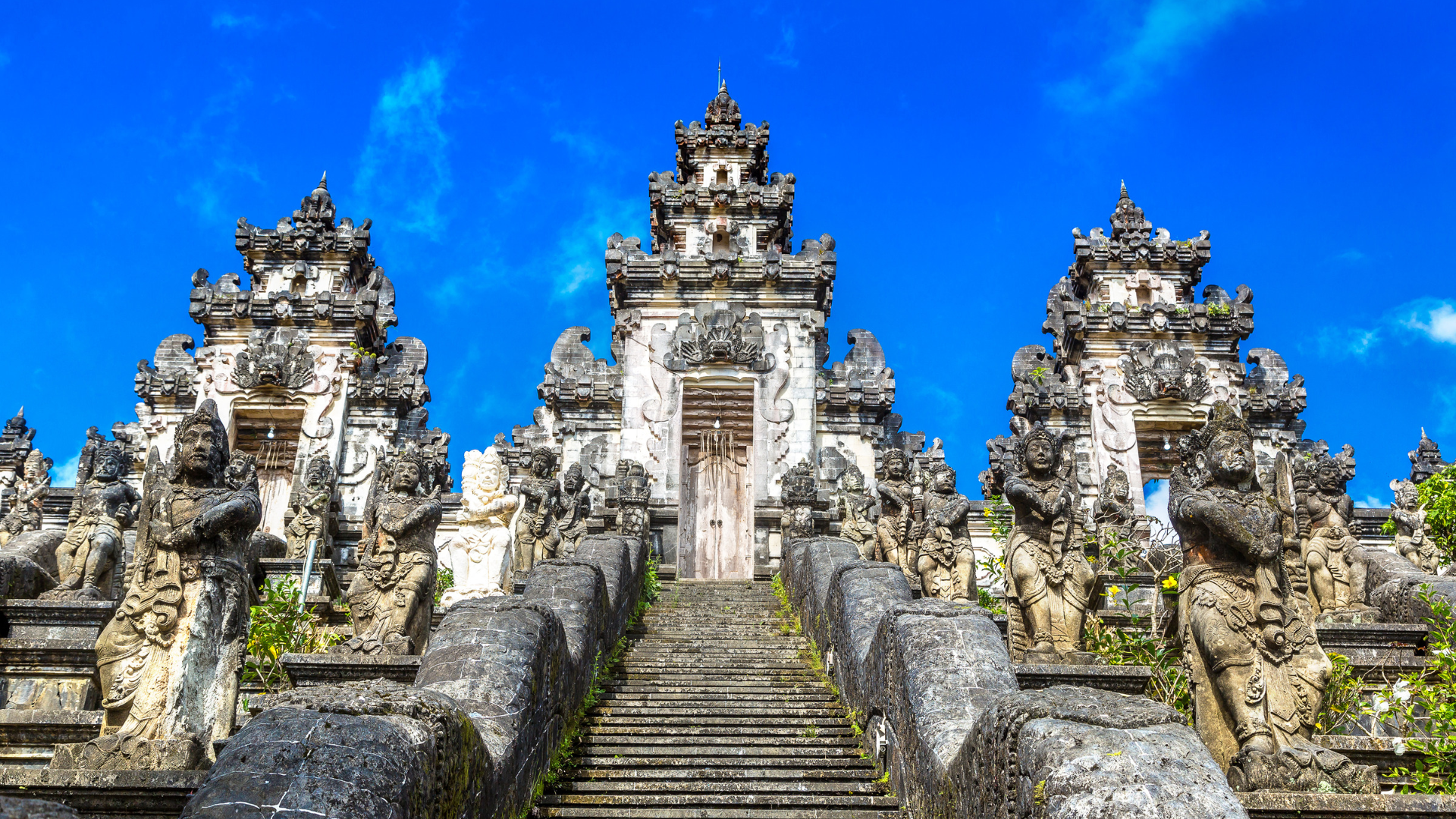
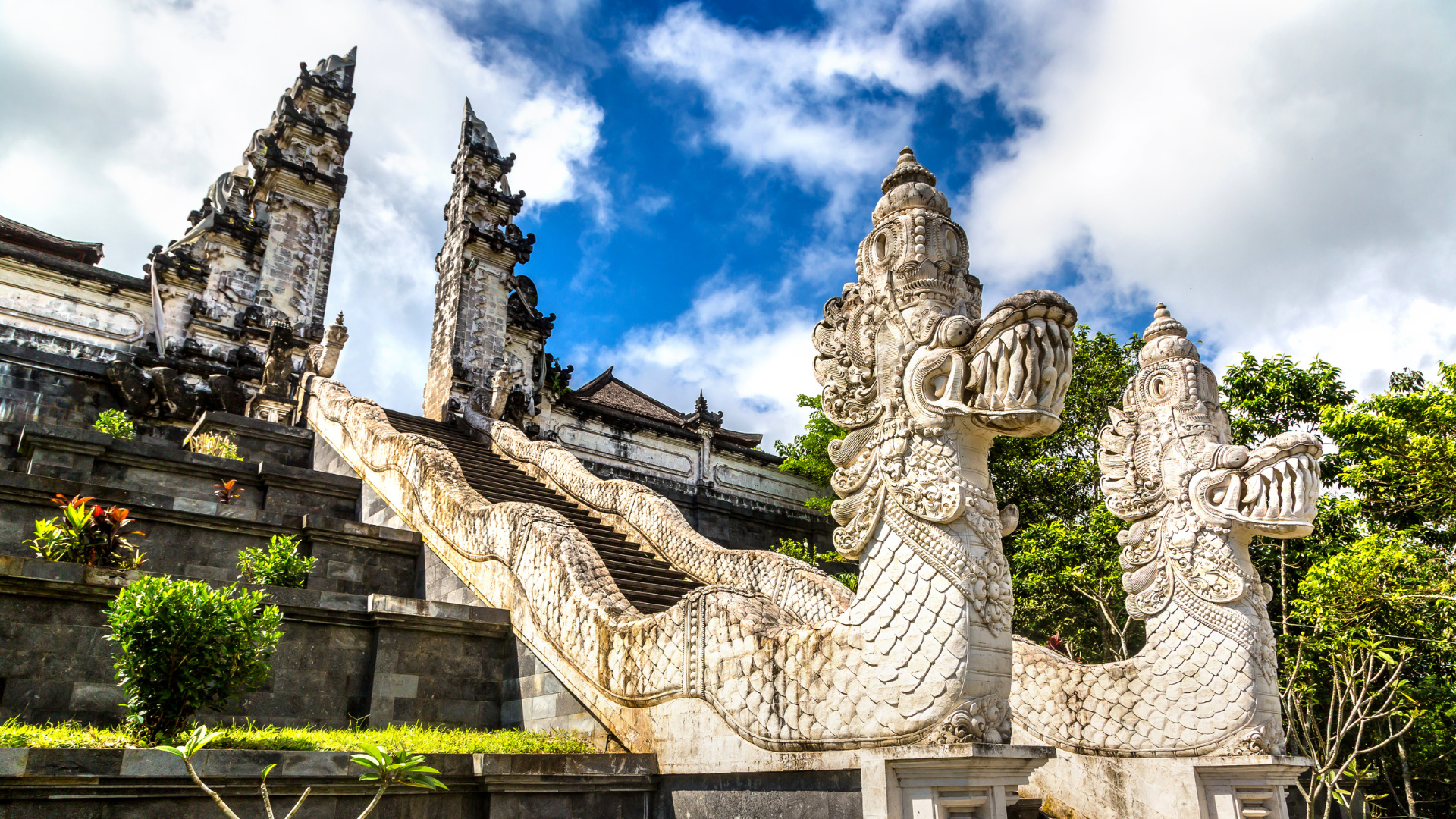
The middle courtyard, the jaba tengah, corresponds to the madya mandala. It is reached by three stairs, each flanked by the long carved bodies of naga serpents whose heads rest at the base and whose tails rise toward the gates. At the top stand three white painted portals in the paduraksa style, a roofed gate form reserved for sacred thresholds. Sculptures of Arjuna, Bima and Yudhishthira, heroes of the Mahabharata, stand among the steps, with a statue of Krishna near the top.
The three white painted portals each serve a purpose. The left portal is for entering and the right is for leaving. The central portal stays closed for most of the year and opens during the temple's main festival, when sacred objects, heirlooms and offerings pass through it. Visitors use the side staircases; the central staircase is reserved.
Jeroan: Utamaning Mandala
The innermost courtyard, the jeroan, corresponds to the utamaning mandala, the most sacred area of the temple. It holds tiered meru towers and pelinggih shrines dedicated to different gods and local deities. Several padmasana shrines take the form of empty stone thrones. These stone thrones honour Sang Hyang Widhi, the supreme god, and the gods of the Trimurti. They stand empty by design: Balinese Hindu belief holds that the divine is present everywhere, so the throne waits as a seat for the god to occupy during worship.
The Gate of Heaven: Meaning Behind the Iconic Photo Spot
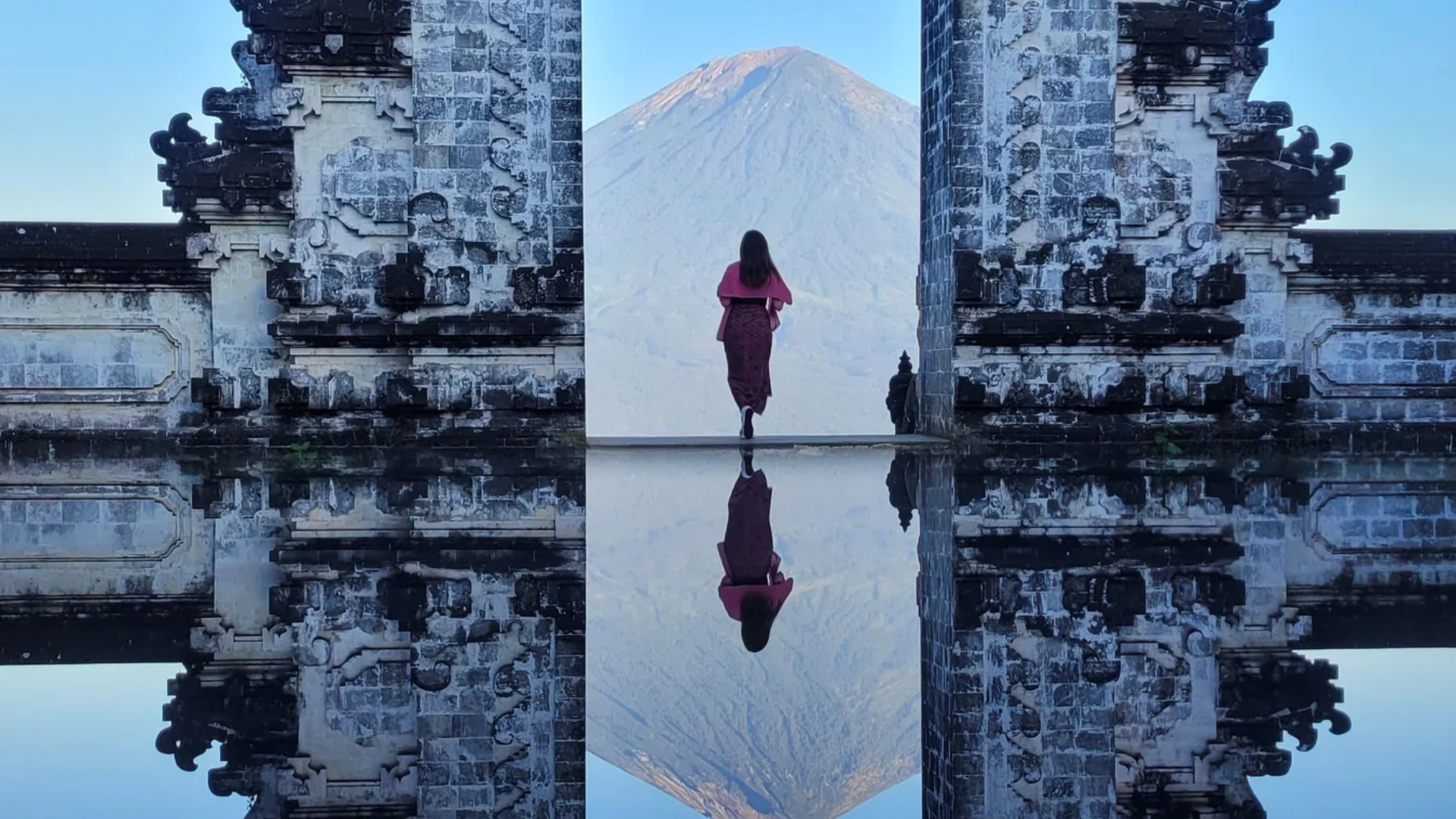
The Gate of Heaven is a candi bentar, a split gate found at the entrance of temples across Bali. Its form carries a clear message. The two halves represent a single mountain split in two, and some interpretations read them as the balance of opposing forces, good and evil, creation and destruction, the visible and the unseen. Passing through the gap marks the move from the outside world into a sacred area.
The gap frames Mount Agung, the home of the gods in Balinese belief. Standing in the gate places a person between the earthly courtyard and the holiest mountain on the island, which is how the name Gates of Heaven Bali came about.
The famous photographs show a perfect mirror reflection of the gate, as if it stands over still water. In reality, the courtyard floor is dry stone. Local photographers hold a small mirror or piece of glass beneath the phone lens to create the reflection. The technique was widely reported in 2019, yet demand for the photo op remains high. Stunning photos are still possible without it: on a clear morning, the gate, the dragon staircases and Mount Agung make a striking scene with the naked eye.
Interesting Facts About Lempuyang Temple
It Belongs to Two Sacred Networks
Pura Lempuyang Luhur is one of the six holiest places in Bali under the Sad Kahyangan Jagad and one of the nine directional temples of the Kahyangan Padma Bhuwana. Few temples on the island hold both roles, which places Lempuyang alongside Besakih Temple in spiritual rank.
The Mountain Has Two Names
"Lempuyang" is the Javanese name. The Balinese name for the mountain is Gamongan, and some older texts refer to Gamongan Hill.
The Gates Follow a Strict Traffic Rule
At the three white painted portals, worshippers enter on the left and leave on the right. The central portal is reserved for sacred objects and opens only during festivals.
The Stone Thrones Are Built to Stay Empty
The padmasana shrines in the inner courtyard are thrones for the supreme god. Their emptiness expresses the idea of a divine presence that exists beyond any fixed physical form.
The Climb Is Part of the Worship
For Balinese pilgrims, the 1,700 steps to the summit are a form of devotion. Complaints about the climb are considered disrespectful, since the journey itself is an offering.
Macaques Share the Path
Grey long-tailed macaques live in the forest around the upper temples. Keep food and loose items packed away on the trail.
The Holy Water Travels Across Bali
Tirtha pingit, the holy water collected at the summit, is carried home by devotees for use in ceremonies in other parts of the island.
Visiting Lempuyang Temple Bali
Visiting Lempuyang Temple Bali takes some planning, as access is managed to protect the mountain roads and the sacred site.
- Getting there: All private vehicles park at Terminal Utama Lempuyang, the official parking area at the foot of the hill. A shuttle service then carries visitors up the narrow road to the temple entrance. The ride takes about 5 to 10 minutes, and the shuttle ticket covers the round trip. The first shuttle departs at around 5:30 in the morning.
- Entrance fee: As of 2026, international visitors pay an entrance fee of IDR 100,000 per person, plus IDR 50,000 for the round trip shuttle. The ticket includes a sarong and sash. The ticket office is cash only, and ATMs at the terminal are scarce, so bring Indonesian rupiah.
- Opening hours: Tourist visiting hours run from 7:00 am to 5:00 pm daily. Balinese Hindu worshippers may enter at any time for prayer.
- Waiting time: The queue for the Gate of Heaven photo is managed with numbered tickets. Arriving at the shuttle terminal by about 5:15 am usually means a short wait. From mid-morning, the waiting time often stretches to two to four hours. Each group typically receives three poses at the gate.
- Dress modestly: Shoulders and knees should be covered. The sarong and sash are mandatory inside the temple and are provided at the entrance. Comfortable shoes with good grip suit the stone steps, which turn slippery after rain.
- Local customs: Lempuyang is an active place of worship. Keep voices low, give way to anyone praying, avoid climbing on shrines or walls, and ask before photographing ceremonies. Drones are prohibited, and public displays of affection are considered inappropriate. Under Balinese custom, women who are menstruating, and people in a period of mourning, are asked to refrain from entering the temple.
- Climbing to Lempuyang Luhur: The full spiritual journey from Pura Penataran Agung to Pura Lempuyang Luhur covers roughly 1,700 steps and takes about 3 to 5 hours round trip, including time at each temple. Local motorbike taxis can shorten the first section of the route. Start early, carry water and allow time to rest.
- Hiring a tour guide: A local tour guide adds real depth to a visit, explaining the shrines, the cosmology and the etiquette of each courtyard. Guides also handle shuttle tickets and queue numbers, which reduces time spent at the terminal.
- Best time to visit: The dry season, from April to October, gives the clearest views of Mount Agung. Morning offers the best chance of a cloud-free sky; cloud often settles over the mountain by early afternoon.
Exploring East Bali From Candidasa
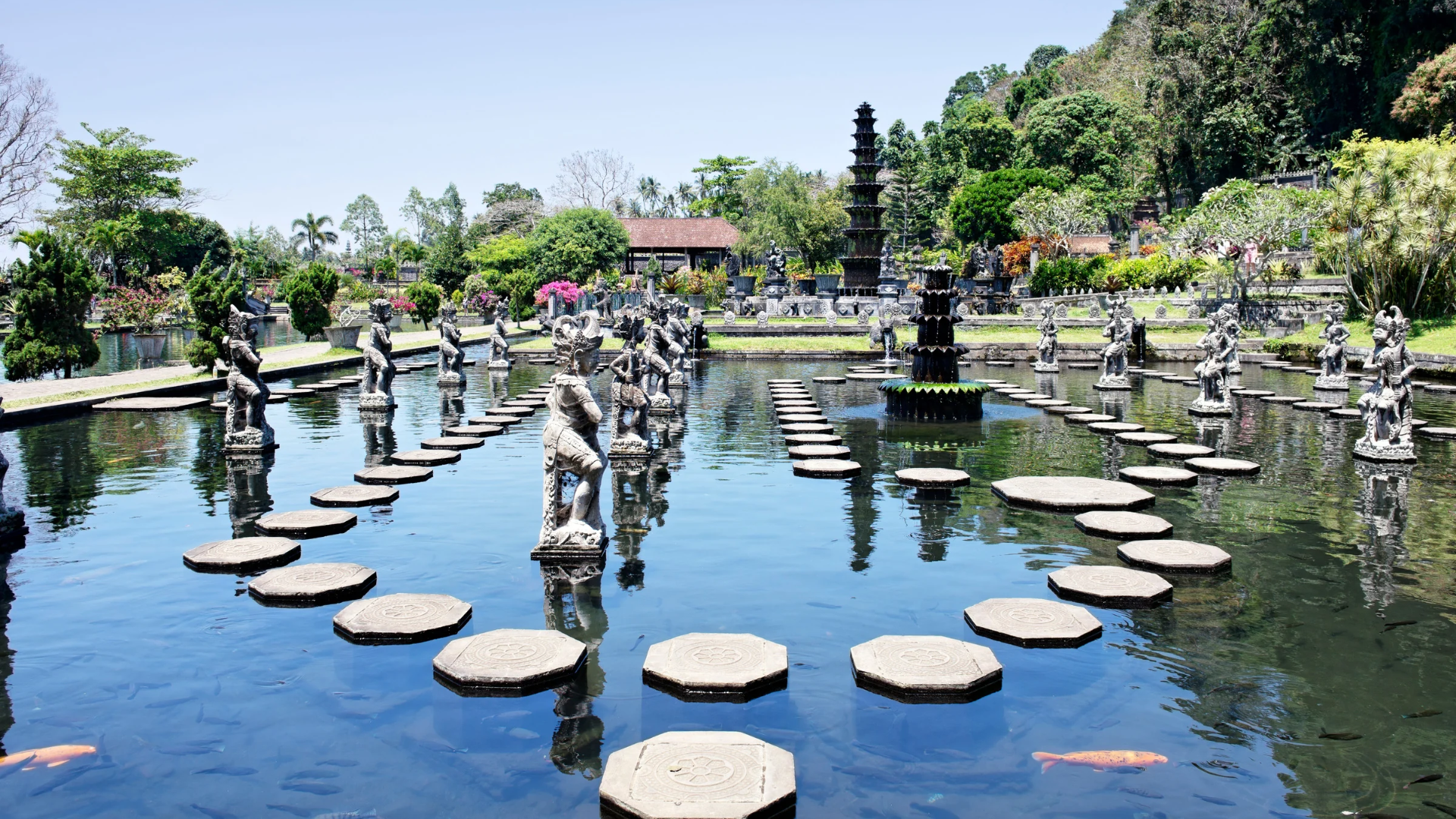
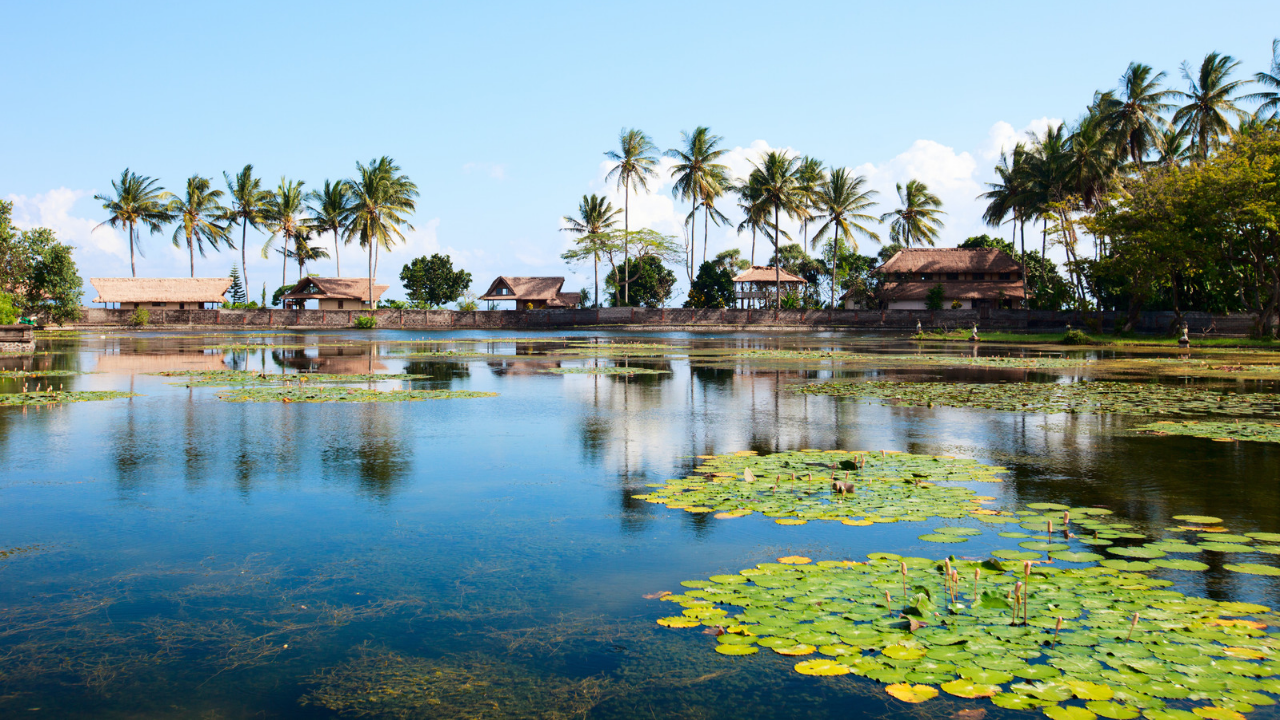
Lempuyang sits at the heart of East Bali, a region of sacred mountains, royal water palaces and traditional villages. Candidasa, on the eastern coast of the Karangasem Regency, is about an hour's drive from the temple, which makes an early start for the morning light straightforward.
Guests at The Seed Bali can arrange a private visit through our concierge, including transport, a local guide and an itinerary that pairs Lempuyang with nearby sites such as Tirta Gangga and Taman Ujung. Explore more options on our Local Discoveries page.
Choose your dates, see the live rate and book your villa in a few minutes.
Book Now
Plan your vacation
Family holidays, reunions, and quiet time together, by the sea in Candidasa.
Learn more →
Host your retreat
A venue for facilitators, with a full hospitality team behind every session.
Learn more →